
| Sixteen chemical elements are known to be important to a plant’s growth and survival. The sixteen chemical elements are divided into two main groups: non-mineral and mineral. | |
| Non-Mineral Nutrients | |
| The Non-Mineral Nutrients are hydrogen (H), oxygen (O), & carbon (C). | |
  |
|
| Since plants get carbon, hydrogen, and oxygen from the air and water, there is little farmers and gardeners can do to control how much of these nutrients a plant can use. | |
| Mineral Nutrients | |
| The 13 mineral nutrients, which come from the soil, are dissolved in water and absorbed through a plant’s roots. There are not always enough of these nutrients in the soil for a plant to grow healthy. This is why many farmers and gardeners use fertilizers to add the nutrients to the soil.The mineral nutrients are divided into two groups: macronutrients and micronutrients.
|
|
| Soil | |
| In general, most plants grow by absorbing nutrients from the soil. Their ability to do this depends on the nature of the soil. Depending on its location, a soil contains some combination of sand, silt, clay, and organic matter. The makeup of a soil (soil texture) and its acidity (pH) determine the extent to which nutrients are available to plants. |  |
Soil Texture
An ideal soil contains equivalent portions of sand, silt, clay, and organic matter. Soils across North Carolina vary in their texture and nutrient content, which makes some soils more productive than others. Sometimes, the nutrients that plants need occur naturally in the soil. Othertimes, they must be added to the soil as lime or fertilizer. Soil pH (a measure of the acidity or alkalinity of the soil)
In this pH range, nutrients are more readily available to plants, and microbial populations in the soil increase. Microbes convert nitrogen and sulfur to forms that plants can use. Lime also enhances the physical properties of the soil that promote water and air movement.
|
|
Month: December 2014
Surprise! I though this was exclusive to cigarettes
Cured Meat Hurts the Lungs
Cured Meat Consumption, Lung Function, and Chronic Obstructive Pulmonary Disease among United States Adults by Rui Jiang in the April 15, 2007 issue of the American Journal of Respiratory and Critical Care Medicine found, “Frequent cured meat consumption was associated independently with an obstructive pattern of lung function and increased odds of COPD.” People who ate cured meats 14 times or more a month had twice the risk of COPD as those who did not eat these meats. COPD is chronic obstructive pulmonary disease, commonly known as emphysema.
Comments: Cured meats, such as bacon, sausage, ham, and luncheon meats, are high in nitrites, used as preservatives, antibacterial agents, and for color fixation. Nitrites generate reactive nitrogen compounds that may damage the lungs, producing emphysema. Therefore, in addition to obvious lung toxins, like cigarette smoke, what people eat can also cause debilitating lung disease. At the other end of the spectrum of food choices, eating fruits and vegetables is associated with healthier lung function.
Foods can be an important part of lung disease prevention, and a healthy diet can also help people with lung disease in three ways:
| 1) A low-fat diet will improve the flow of blood to the lungs. A high-fat diet has been shown to reduce the oxygen in the blood by 20%. |
| 2) Removal of dairy products, and sometimes wheat products, will decrease the amount of thick mucous produced in the airways. |
| 3) Losing excess weight will reduce the compression on the lungs caused by an obese abdomen. |
Jiang R, Paik DC, Hankinson JL, Barr RG. Cured Meat Consumption, Lung Function, and Chronic Obstructive Pulmonary Disease among United States Adults.
Am J Respir Crit Care Med. 2007 Apr 15;175(8):798-804.
Pasta Primavera
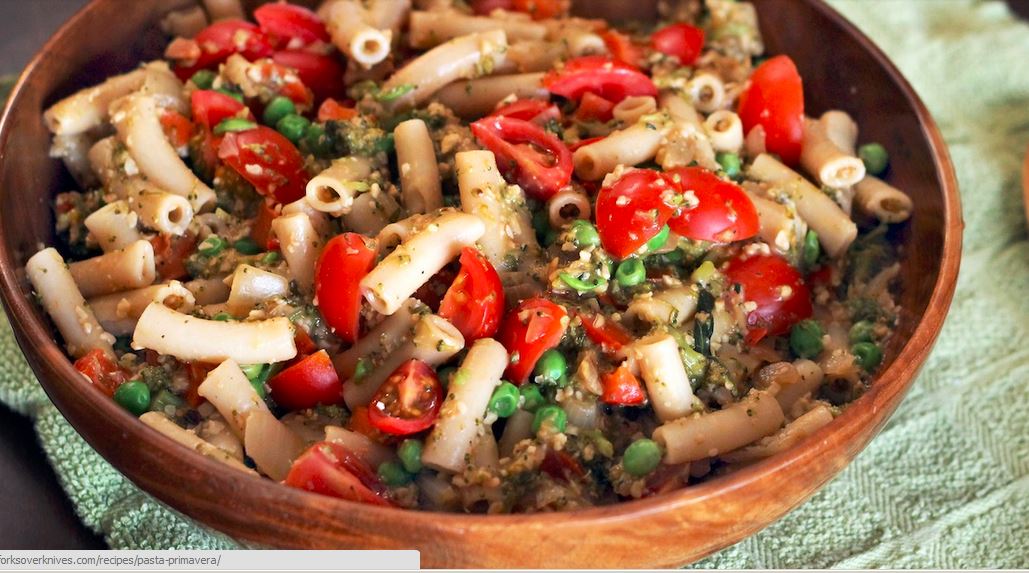
Pasta Primavera
INGREDIENTS:
- 12 ounces quinoa penne
- 3 cups broccoli, chopped
- 2 cups carrots, diced
- 1 onion, diced
- 1 cup red bell pepper, diced
- 1½ tablespoon garlic granules
- 2 cups low-sodium vegetable broth
- ½ cup raw cashews
- 1 cup soy milk
- ½ cup oat flour
- 2 cups green peas
- ¼ teaspoon black pepper
- 2 teaspoons dried basil or 2 tablespoons fresh
- 2 teaspoons dried oregano or 2 tablespoons fresh
- 1 cup cherry tomatoes, halved
Essential amino acids
Introduction
Why learn this?
Amino acids play central roles both as building blocks of proteins and as intermediates in metabolism. The 20 amino acids that are found within proteins convey a vast array of chemical versatility.  The precise amino acid content, and the sequence of those amino acids, of a specific protein, is determined by the sequence of the bases in the gene that encodes that protein. The chemical properties of the amino acids of proteins determine the biological activity of the protein. Proteins not only catalyze all (or most) of the reactions in living cells, they control virtually all cellular process. In addition, proteins contain within their amino acid sequences the necessary information to determine how that protein will fold into a three dimensional structure, and the stability of the resulting structure. The field of protein folding and stability has been a critically important area of research for years, and remains today one of the great unsolved mysteries. It is, however, being actively investigated, and progress is being made every day.
As we learn about amino acids, it is important to keep in mind that one of the more important reasons to understand amino acid structure and properties is to be able to understand protein structure and properties. We will see that the vastly complex characteristics of even a small, relatively simple, protein are a composite of the properties of the amino acids which comprise the protein.
Top
Essential amino acids
Humans can produce 10 of the 20 amino acids. The others must be supplied in the food. Failure to obtain enough of even 1 of the 10 essential amino acids, those that we cannot make, results in degradation of the body’s proteins—muscle and so forth—to obtain the one amino acid that is needed. Unlike fat and starch, the human body does not store excess amino acids for later use—the amino acids must be in the food every day.
The 10 amino acids that we can produce are alanine, asparagine, aspartic acid, cysteine, glutamic acid, glutamine, glycine, proline, serine and tyrosine. Tyrosine is produced from phenylalanine, so if the diet is deficient in phenylalanine, tyrosine will be required as well. The essential amino acids are arginine (required for the young, but not for adults), histidine, isoleucine, leucine, lysine, methionine, phenylalanine, threonine, tryptophan, and valine. These amino acids are required in the diet. Plants, of course, must be able to make all the amino acids. Humans, on the other hand, do not have all the the enzymes required for the biosynthesis of all of the amino acids.
Why learn these structures and properties?
It is critical that all students of the life sciences know well the structure and chemistry of the amino acids and other building blocks of biological molecules. Otherwise, it is impossible to think or talk sensibly about proteins and enzymes, or the nucleic acids.
http://www.biology.arizona.edu/biochemistry/problem_sets/aa/aa.html
How come plants can make essential amino acids but people can’t?
How come plants can make essential amino acids but people can’t? After all, both need the same amino acids to survive.
-A curious adult from California
February 8, 2011
That’s a great question! When you think about it, it does seem weird that most animals don’t make a lot of the amino acids they need to survive. But it isn’t.
Animals get these amino acids by eating plants or animals that eat plants. This works because plants can make all twenty amino acids including the ten or so “essential” ones that most animals can’t. Another good reason to eat your veggies!
Animals evolved to work this way because it saves energy. Any of our distant ancestors that lost the ability to make these amino acids had extra energy for other things. And apparently that extra energy helped them thrive. In fact, they did so well that eventually only their offspring survived.
And we all come from these survivors. The end result is that animals (including us) have lost the ability to make many of their amino acids.
What I want to do for the rest of the answer is talk about how species can lose the ability to do things over time. And to do this, I need to take a step back and talk about genes, mutations, and something called pseudogenes.
Change can be Good
Genes are chunks of DNA that tell our cells what to make, like recipes in a cookbook. But DNA can change and sometimes this will change the recipe. Which will change what gets made.
This is like when a family recipe gets passed on. Sometimes someone in the family tweaks a recipe to improve it. The next generation then gets this improved recipe.
Changes in your DNA are called mutations instead of tweaks. Mutations in a gene can either be good, bad, or have no effect.
Kind of like our family recipe. If someone rewrites it in cursive or changes the measurements to metric, then the changes don’t have any effect. But if they change how the dish is cooked, then it might be good or bad.
For our genes, good mutations might let us save energy by “turning off genes” and stopping us from making something (like amino acids). They might also help us do things better like being able to drink milk as an adult. These might be like changing up a cake recipe so the cake cooks for a shorter time to make it moister.
Bad mutations might be those that can cause us problems, like alcohol intoleranceor even genetic disorders like Huntington disease. This might be like cooking the cake for such a short time you end up with a goopy mess.
Mutations that are very good are more likely to get passed on to the next generations. Just like the improved family recipe.
When a gene gets shut off because of a mutation, it is like someone misplacing the family recipe. It is still there, we just can’t find it so we don’t use it.
The DNA that makes up the broken gene stays around…even after millions of years! And as you’ll see below, sometimes our cells can find that lost recipe and fix it so they can use it again.
Scientists call this a pseudogene and they find pseudogenes by matching up similar chunks of DNA between different species. Scientists have found pseudogenes in animals that are almost certainly parts of the old machinery for making the essential amino acids. So we had working versions of these genes at one time, but now they are broken.
Before getting into more detail about pseudogenes, I think it is worth thinking more about how losing a gene might be useful. It helps me to think about the process if I think about those genes as various car parts.
Less is More
A Model T is definitely different from a Focus, a Prius or a Leaf. Along the way, parts were changed, added, and even lost.
For example, the parts that are involved in fuel processing have DEFINITELY changed since the invention of the first gasoline powered car. Many rounds of improvements were needed in the gasoline processing to increase those MPGs!
Eventually hybrids were invented and I think we can all agree that was a step forward when it comes to fuel efficiency. However these cars still use gasoline, so the traditional parts used in fuel processing are still there, but not used as much.
Now companies are making electric cars. They don’t need the car parts that deal with gasoline. So those parts are tossed out of the design.
Genes like the ones that make essential amino acids are like the fuel processing parts in electric cars and were eventually shut off/”lost” when they weren’t needed. Electric cars don’t need parts dealing with gasoline just like you don’t need genes dealing with essential amino acids. We both now get our energy from different sources!
Now that we’ve got a good handle on losing genes, we’re ready to dive back into the topic of pseudogenes. Ideally at this point I would now talk about those amino acid making genes we animals all lost millions of years ago.
The problem is that scientists, for whatever reason, haven’t yet done a lot of work on these. What I’ll do instead, is talk about a pseudogene involved in making vitamin C. And how it got turned back on in some birds.
We Didn’t Always Need Oranges
You’ve heard of vitamin C right? Most plants and animals can make vitamin C out of sugar but humans, and our closely related primates (monkeys and apes), can’t.
Making vitamin C from sugar takes lots of genes that all have to work one right after the other. Primates have a mutation in a gene called GULO (short for L-gulonolactone oxidase) that wrecks the recipe. This gene, the last step for making vitamin C, is now a pseudogene in humans.
The GULO story is even more interesting in birds. Some birds have a working GULO while others don’t…nothing crazy there. But it looks like some bird species that lost the ability to make vitamin C actually regained it millions of years later. They found that old family recipe that had been lost.
Their damaged recipe was repaired so they could now make their own vitamin C again. A good reason to keep these relics around in our DNA!
Pseudogenes are related to more than amino acids or vitamins. Humans alone have lost genes involved in smell, taste and immunity. In fact there have been thousands of human pseudogenes identified over the last few years.
More about vitamin C pseudogenes. Guinea pigs have a different mutation knocking out the GULO gene compared to primates like us.

Dr. Jan DeNofrio, Stanford University
Plant Nutrients
| Sixteen chemical elements are known to be important to a plant’s growth and survival. The sixteen chemical elements are divided into two main groups: non-mineral and mineral. | |
| Non-Mineral Nutrients | |
| The Non-Mineral Nutrients are hydrogen (H), oxygen (O), & carbon (C). | |
|
|
| Since plants get carbon, hydrogen, and oxygen from the air and water, there is little farmers and gardeners can do to control how much of these nutrients a plant can use. | |
| Mineral Nutrients | |
| The 13 mineral nutrients, which come from the soil, are dissolved in water and absorbed through a plant’s roots. There are not always enough of these nutrients in the soil for a plant to grow healthy. This is why many farmers and gardeners use fertilizers to add the nutrients to the soil.The mineral nutrients are divided into two groups: macronutrients and micronutrients.
|
|
| Soil | |
| In general, most plants grow by absorbing nutrients from the soil. Their ability to do this depends on the nature of the soil. Depending on its location, a soil contains some combination of sand, silt, clay, and organic matter. The makeup of a soil (soil texture) and its acidity (pH) determine the extent to which nutrients are available to plants. | |
Soil Texture
An ideal soil contains equivalent portions of sand, silt, clay, and organic matter. Soils across North Carolina vary in their texture and nutrient content, which makes some soils more productive than others. Sometimes, the nutrients that plants need occur naturally in the soil. Othertimes, they must be added to the soil as lime or fertilizer. Soil pH (a measure of the acidity or alkalinity of the soil)
In this pH range, nutrients are more readily available to plants, and microbial populations in the soil increase. Microbes convert nitrogen and sulfur to forms that plants can use. Lime also enhances the physical properties of the soil that promote water and air movement.
|
|
Back in Circulation: Sciatica and Cholesterol
Atherosclerotic plaque clogging the arteries feeding our spine may lead to low back pain, disc degeneration, and sciatic nerve irritation.
Comfortably Unaware


Let’s get it right: it’s not drought or climate change that is wreaking havoc on water supplies in California or anywhere else in the southwest U.S. … it’s what we are eating.
.
60 Minutes, Leslie Stahl, and the real issue at hand
On November 16, CBS aired a 60 Minutes episode called “Water,” where Leslie Stahl reported to over 12 million viewers “new evidence” that our planet’s groundwater is being pumped out much faster than it can be replenished. The story focused primarily on the scarce water conditions in California. While Ms. Stahl’s findings were important to emphasize, they were nothing new. Whether in California or globally, audiences will eventually need to hear the truth about freshwater scarcity as it relates to our current and projected water-management trends: where all of our freshwater supplies are going and what we can do about it.
Those living in California and the Southwest U.S find themselves embedded in a significant four-year drought and have turned to strategies such as rationing water, educating the public about conventional conservation tactics (such as shortening shower times), and even approving $500 fines for overwatering lawns.
On average 2 to 3 gallons of water can be saved by reducing your time in the shower by one minute or by turning the water off while brushing your teeth. However, you can save more than 1,000 gallons per day by eliminating meat and dairy from your diet. That’s the average amount of water required to produce the nine ounces of meat that every American consumes per day, on average.
Raising livestock plunders global resources and devastates our water supply
In some areas of the southwest U.S., including California, it requires over 4,000 gallons of water to produce just one pound of beef and over 1,000 gallons to produce just one gallon of milk–as compared to, on average, 6 to 30 gallons to produce a pound of vegetables, such as carrots or various greens.
Using land and water to raise livestock and to grow crops to feed them is a tremendously inefficient way to produce food. It wastes energy, resources, and lives. With a burgeoning global human population expected to reach 9.6 billion by the year 2050 (2.5 billion more than we have now), there will come a time where growing plants for direct human consumption will be the only socially (and perhaps legally) acceptable way to deploy our finite resources for food production, whether in California or anywhere else in the world.
The state of California raises over 6 million cattle and 2 million dairy cows. Each animal drinks between 20 gallons (grazing beef cattle) and 40 gallons (dairy cow) of water daily. An additional 2 million annual gallons of virtual water (the amount of water used in the entire production process of an agricultural product) are tied up in grain and pasture to feed just one cow. Annually, this is over 100 times more water than one human drinks and is 130 times more than what is used to produce food for one person each year if eating a purely plant based diet.
Pastured livestock: far from sustainable
Many people consider raising livestock on pasture to be a more “sustainable” way to produce meat and dairy. But if we examine the water that just one of the two billion grass-fed cattle in the world drinks (not accounting for the significant additional water required for feed, slaughtering, or processing), it would still require 20,000-22,000 gallons over a 24-month period to raise just one grass-fed cow. That amount of water is the equivalent of a person taking a five-minute shower each and every day for 6.7 years. Indeed, when accounting for land and water use inefficiencies, net greenhouse gas emissions, effect on biodiversity, and ratios of end product consumed per resources required, pastured animal agricultural systems are LESS sustainable than factory farming.
Loss of the Colorado River via alfalfa
Every year, California devotes 900,000 acres of its land to growing alfalfa, ninety-five percent of which is eaten by cattle (the other five percent by horses). Each one of these 900,000 alfalfa acres receives irrigation to the tune of 1 to 2 million gallons per year (50-80 acre inches per acre per year). Therefore, total freshwater used in California for just one year of hay production is 1.8 trillion gallons.
Each year, California uses 1.8 TRILLION gallons of freshwater to produce hay for livestock.

In California’s Imperial Valley, one-fifth of all the water from the Colorado River is diverted through the Imperial Canal, and 70 percent is used in one way or another for livestock. The average yearly rainfall in the Imperial Valley is less than 3 inches, and water is sparse in other areas in California where alfalfa hay is grown.
Knowing this, it is shocking that the largest importer of California hay for the past few years has been the United Arab Emirates (UAE), which is importing hay because it is concerned about the scarce water supply for its own citizens. Saudi Arabia will soon follow, essentially importing water from California via hay for its animals, which are then consumed by Saudi citizens. This virtual water trading loss will be a growing trend—certain countries depleting the natural resources of other, more unaware countries, such as the U.S., Brazil, and others, so they may “prosper” with importation of animals and animal products.
These animals are produced in countries where true environmental costs of production continue to be externalized, and a proper economic metric has yet to be affixed to the raising and slaughtering of livestock and fish, the largest contributors to global depletion. Opportunistic countries with dwindling natural resources will continue to take an approach similar to that of the UAE by utilizing their limited water supply more for human consumption than for crop or animal production, while taking advantage of countries such as the U.S., which doesn’t know any better or is letting economics dictate ecological reasoning.
Historically, the U.S. has heavily subsidized use of aquifer water for livestock and feed crops, such that farmers in the Ogallala and San Joaquin regions of the western U.S. (home of two of the largest aquifers on Earth) pay only 5 to 10 percent as much for their water as do residents in those areas. This has encouraged continued alfalfa and feed crop production and freshwater depletion.
“Subsidence”: ground craters where water once lived …
Typically, most areas of the world predominantly use either surface water (lakes, streams, rivers) or groundwater (aquifers). California uses a combination of both, in an approximately 60/40 ratio, blending the surface waters of the Sacramento-San Joaquin River Delta and the diverted Colorado River with underground water from the San Joaquin aquifer and others. In times of drought, California places restrictions on surface water and relies heavily on withdrawals from aquifer systems.
Visual indicators of these water withdrawals can be seen in many areas, most notably, perhaps, near Mendota, California, where a 1977 study showed land elevation having dropped as much as 28 feet in some areas. Known assubsidence, this phenomenon occurs when ground cratering results after excessive amounts of groundwater have been withdrawn from an aquifer. Once water has been removed from the sediment and subsidence has taken place, it cannot be replaced.
Subsidence can also be readily seen in many Texas counties and elsewhere in the world. It is occurring in the state of Guanajuato, Mexico, where the water table is falling by 2 meters or more per year, due to the withdrawals required to support the growing livestock and feed crop industry there.
Worldwide, there are many examples of rapid groundwater depletion. India is witnessing losses due to the irrigation of rice fields, and the North China Plain is quickly depleting its two aquifer systems because of expansion of animal agriculture. In the U.S., there is depletion of aquifers due to livestock and feed crop operations in North Carolina, Arkansas, the Columbia River Basin, and especially in California’s Central Valley, the focus of Ms. Stahl’s report.
“The single largest human alteration of land”
The San Joaquin Valley forms the backbone of California’s agricultural industry, the nucleus of the Central Valley area, which produces 25 percent of the nation’s food on less than 1 percent of the country’s farmland. Land subsidence in excess of 1 foot has affected more than 5,200 square miles of irrigable land—one-half the entire San Joaquin Valley. The USGS has called this “the single largest human alteration of land.” It, along with depletion of the Ogallala, will likely be the single largest human alteration of water, as both the San Joaquin and Ogallala aquifers are expected to be completely drained in coming decades (within sixty years for the former and as soon as 2030 for the latter).
Abuse of the Ogallala
At an average depth of 200 feet, the Ogallala is the most heavily depleted aquifer in the U.S. and the world’s fastest-disappearing freshwater source, having lost 150 feet of depth in the past twenty years. It contains water formed from glaciers 12 million years ago, has a recharge rate of less than a half-inch per year, and is being drawn down at a rate of 3 to 10 feet per year.
Since the 1960s, farmers have irrigated this land, receiving subsidies to use this water to grow crops to feed cattle. Almost half of all cattle raised in the U.S. come from just four states in this area—Nebraska, Iowa, Kansas, and Texas, which accounted for 49 percent of the United States commercial red meat production in 2010.
The vast majority of the Ogallala abuse and depletion has occurred in support of the largest cattle herds in the U.S. and the corn that feeds them–a vivid example of just how much power various influences exert over our decisions about food. When confronted with the very real potential of running the Ogallala aquifer dry, a movement in the late 1980s supported creating a pipeline to pump water from Lake Michigan, one of the great lakes, back to all the livestock operations. This brings us front and center to the real problem—water management and food choice.
We need to find another solution. We could, for instance, eat all plant-based foods, which are far less water intensive. We do not need to eat cattle from the High Plains states or anywhere else to live thriving, healthy lives. We do, however, need water.
Water by the numbers, globally and in the U.S.
Worldwide, alfalfa is grown on approximately 79 million acres. The majority of it is irrigated, and 70 percent of it comes from the United States, Russia, and Argentina—countries suffering now from frequent periods of heat, drought, and water stress. Wherever water scarcity is found in the world, particularly with irreversible overdrawing of aquifers, livestock is typically involved, leaving the indelible mark of our insatiable demand to eat them.
Between 50 and 75 percent of all water withdrawal from the largest aquifers in the world—the Ogallala, North China Plain, San Joaquin, and Columbia River Basin—can be attributed to livestock and the alfalfa, corn, sorghum, and other crops they eat, the water they drink, and the water used to generally service and slaughter them, as well as to the processing and packaging of animal products.
In the U.S., livestock consume 34 trillion gallons of water per year, accounting for nearly 50 percent of all freshwater-consumptive withdrawals.
Each year, the U.S. livestock industry uses 34 TRILLION gallons of freshwater.
Globally, agriculture is responsible for 92 percent of all freshwater use, 30 percent of which goes to livestock and crops or pasture to feed them.
The China connection

Most of China’s arable land and freshwater supplies are polluted and dwindling, so they are turning elsewhere to help supply their growing demand for pork, dairy, and other meat products. China’s demand for meat has quadrupled since 1980, and it now consumes over 50 percent of the world’s production of pork and 60 percent of the world’s soybeans. Feed crops such as corn and even wheat grown in drought-ridden areas of the U.S., such as the southwest and middle corn belt, are irrigated with water from rapidly depleted ancient aquifers to feed livestock grown in China and elsewhere, while U.S. policy makers are scratching their heads to find solutions to a growing freshwater scarcity issue.
Robert Glennon, a water policy expert at the University of Arizona, calculated that approximately 100 billion gallons of western U.S. water—enough to supply the annual household needs of one million families—were being exported to China in the form of alfalfa crops grown with irrigation water from the Colorado River and dwindling aquifers in California and Arizona.
Refocusing of issues—animal agriculture, climate change, and global depletion
Regarding sustainability issues, most of the world’s attention recently has been focused on climate change and greenhouse gas emissions—energy and fossil fuel use. But climate change is only one component of the much larger, more insidious concern of global depletion. It is an exacerbator, taking these pressing issues and making them worse.
Climate change is not the sole cause of various aspects of global depletion, such as agricultural land use inefficiencies, oceanic ecosystem devastation, rainforest deforestation and degradation, food insecurity, accelerated extinctions and loss of biodiversity, and freshwater scarcity. All of these phenomena are occurring with or without the effects of climate change … with or without the use of fossil fuels. The primary driver of all of these combined issues worldwide is the raising, harvesting, slaughtering, and consumption of animals.
Regarding our state of sustainability, make no mistake that we are in overshoot mode. According to the Global Footprint Network, it would require more than 1.5 Earths to sustain what we are currently taking from and doing to our planet, and no other single factor contributes to our unsustainability as significantly as our demand for meat, dairy, fish, and eggs and the agricultural systems that support these products.
Timelines of irreversibility
All aspects of global depletion are marked by timelines—the number of years before tipping points may be reached and thus cause irreversibility. To wit:
- Global warming: Most researchers agree that our planet will display irreversible effects if we have not drastically reduced greenhouse gas emissions by 2017.
- Oceans: With massive loss of sea life (90 percent of all large fish species are gone) due to commercial fishing, warming waters, and 30 percent acidification, irreversibility has already occurred in our oceans. It has been 300 million years since the last time our oceans have been this warm and acidic, and at that time, it took over 30 million years to recover.
- Tropical rainforests: Since 1978 over 300,000 square miles of tropical rainforest in the Amazon have been destroyed. Ninety percent of the destruction in Brazil and between 70 and 80 percent of rainforest destruction in the other seven Amazonian countries has been due to grazing livestock and growing feed crops. The diverse wildlife lost will never be seen again in our lifetime.
- Species extinction: Similarly, with the massive number of species extinctions (occurring at up to 10,000 times the annual background rate) and loss of biodiversity, we are already witnessing irreversibility. For some species with whom we share this planet, time has already run out. Cause of extinction: humans.
… And so it is with the availability of freshwater.
One of our most critical concerns regarding sustaining current and future life on Earth is our supply of freshwater. From 1941 to 2011 the world’s population tripled, but freshwater consumption quadrupled. The gap between worldwide demand for water and what is really available is growing at such a rate that a 40% shortage in water supply is expected in just 15 years.
Water and geopolitics
Although the amount of water on earth remains constant, the consumptive form it happens to be in does not. Four out of five people now live within 30 miles of a water-damaged area (meaning soon to run out, or polluted), and there are nearly 300 transboundary river and waterways on Earth where multiple countries share vital running water supply. As we see water shortages over the next fifteen years, we will surely see droughts, famine, and human sickness. And then we’ll see conflicts, social unrest, and even wars. Indeed, those living downstream will be fiercely battling those living upstream for water rights.
Climate change will make these matters worse, but it will not cause them. Food choice and virtual water trading through food, especially with animal products, will play much larger roles than energy and fossil fuel use.
As we continue irreversibly damaging the environs that support us and all other life on Earth (lithosphere, hydrosphere, and atmosphere) and begin running out of freshwater, topsoil, arable land, fish in our oceans, and tropical rainforests–creating extinctions of other species and loss of biodiversity–we will come to accept that sustainability of our own species is contingent upon the choices we make. While scientists and policy makers are concerned about advancing technologies, we should be first concerned about our decisions, particularly those decisions that have the most profound effects on the health of our planet and our own health, such as food choice specifically related to animal agriculture.
The easiest solution to any area of global depletion can be found by adopting a more optimal level of relative sustainability—and to do so today, as the timelines of irreversibility are imminent and the clock is ticking.
A plea for equal time
As usual, 60 Minutes and Ms. Stahl’s “Water” segment presented an entertaining story to over 12 million viewers with a report of a real-life problem, consisting of selected interviews, a possible solution, and even a sprinkling of space technology (GRACE satellite information). But instead of resorting to “toilet-to-tap” recycling of waste water as perhaps the last resort to solving our problem of freshwater scarcity as indicated in the report, we need to hear where the overwhelming majority of our water is going and how this relates to the profound issue of agricultural system inefficiencies. We need to hear about the most sensible manner in which we can produce food … and why it needs to be donetoday.
Let’s move the critical mass in the right direction and do so now. Let’s all contact Ms. Stahl, asking her to seriously consider reporting on how animal agriculture is the sector most responsible for global depletion. Ask her to clearly spell out to her massive audience that the timelines necessary for action are upon us and that immediate and complete replacement of animal products by organically grown, whole-plant-based food alternatives is necessary to ensure the highest level of relative sustainability for our species. Remind her that this topic should not be considered political, nor should her reporting of it be constrained by cultural or economic bias, because it is a topic of our survival and that of future generations.
It’s a story about health, peace, truth, and social justice. It is a story about saving resources, saving lives, saving species, saving humanity. As such, it should be considered the most important topic we have in front of us today—the most worthy of conveying. This is the report we all need to hear.
Dr. Richard Oppenlander
Protein

Answer to a Reader’s Question:
Many people are rightfully confused about the various ways that protein recommendations are established, and fail to know the main factors that have caused the confusion. Understanding the protein recommendations requires an understanding of the history of protein research and the serious bias that crept into the science over the years. From the beginning, there was a very strong bias that has emphasized the health importance of protein and this almost always meant animal-based protein. This bias arose even though the research results clearly showed in many cases that it SHOULD NOT be emphasized. Nonetheless nutrition researchers still emphasized higher consumption of protein because it was the “sign of civilization itself” as was said in the early 1900s and, further, that those who did not consume these generous amounts of protein (i.e., meat) were “of an effeminate nature”!
Researchers continually pushed the protein idea and continually found ways to develop methodologies and algorithms to ‘show’ that higher levels of protein were advisable. The whole concept of protein “quality” was devised so that it could be said that animal protein was high quality and plant proteins were low quality when, in fact, the concept of quality only indicated a biological efficiency of utilization per unit protein consumed. Naturally, animal-based proteins more nearly mimic our needs because they are composed of the right ratio of amino acids, thus are used more efficiently. But these studies were mostly based on animal production research that served the farm community (also served for my PhD thesis!) far more than it served the interests of human health. More efficiently used “high quality” proteins also efficiently grow cancer cells as well!
However, it’s important not to miss the really bizarre point that the current US dietary guidelines advocate an upper limit of 35% of calories as protein that is supposedly consistent with minimizing chronic diseases. The only way that one can go this high is to be a virtual carnivore. The correct recommended intake is around 8-10% protein (not 35%!) which can be easily supplied by a good whole foods plant based diet. Even potatoes will do the job alone.
So, it’s back to the question of how and why and who is recommending these ridiculous numbers. The first time that these new high limits appeared was when a top consultant to the dairy industry, was chairing the Food and Nutrition Board that was responsible for the report. That report was funded by the dairy industry-based Dannon Institute, among other corporate benefactors who, accidentally I suppose, rather liked these high protein recommendations.
This is where Dr. Caldwell Esselstyn’s research that was focused on low fat intake and my research that was initially focused on lower protein intake converged, pointing to the elimination of animal based food consumption that was so highly correlated in international studies with Western diseases.


Why China Holds the Key to Your Health

I have been a researcher, lecturer, and policy advisor in the field of diet and cancer for nearly 45 years.
Since 1963, primarily from an academic position, I have seen the many faces of establishment science and have been both rewarded and distressed by what I have witnessed. I have seen a vast increase in consumer nutrition information and, regrettably, an almost equal increase in consumer confusion. One week we hear that eating meat increases our risk of colon cancer, the next week the exact opposite. One news report states that dietary fat is not related to breast cancer, another says it is. It seems to me that public confusion has grown far beyond acceptable limits.
In the 1980s, I was invited by Senator John Glenn’s U.S. Senate Committee on Governmental Affairs to offer an opinion about why there is so much confusion. My opinion then and now is that we tend to think so specifically about ideas and products that we fail to comprehend the main message. We stare fixedly at the trees and miss the forest. Specific ideas and products provide immediate money for the entrepreneur, grant money for the scientific researcher, and some degree of presumed “certainty” for the educator and publicist. They do not necessarily promote good health. Despite all our products and proclamations, more people are overweight in the U.S. than ever before. By the latest count one out of every three adults is overweight, an increase from one in four in the late 1970s.
The real aim of science is to advance knowledge about what makes you healthy, reduce your confusion, and alleviate human suffering. When I look at these problems strictly from the science point of view, I know there can be no quick intellectual fix. But I also know that the present confusion is beyond reasonable limits and something new is required. Thus, my colleagues and I felt that a newsletter of a different kind could provide a starting point. From this was born the idea of Nutrition Advocate, a newsletter advocating a diet based on a variety of quality plant foods and providing simple explanations so you can make reasonable decisions at your own pace.
As practicing scientists and researchers, we believe that we have done our homework. The science presented in these pages is the best that we can provide. Much of our research is based on the Cornell-Oxford-China Study (“China Project”), the most comprehensive survey of the connection between diet and disease in world medical history. The New York Times hailed this investigation, directed from Cornell University, as the “Grand Prix of all epidemiological studies.” These discoveries have vigorously challenged and altered existing conceptions about nutrition and health. We are now prepared to share more of these findings so you might join us in our excitement.
Why We Went To China
Previous studies relating nutrition to degenerative disease have mostly been limited to consideration of single factors and single diseases. Yet even when large surveys have been taken, they have generally produced mixed results. This is because these studies have largely been conducted in the developed world, where everybody eats more or less the same thing.
The China Project offers a rare opportunity to study disease in a precise manner because of the unique conditions that exist in rural China. Approximately 90% of the people in rural China live their entire lives in the vicinity of their birth. Because of deeply held local traditions and the absence of viable food distribution, people consume diets composed primarily of locally produced foods. In addition, there are dramatic differences in the prevalence of disease from region to region. Various cardiovascular disease rates vary by a factor of about 20-fold from one place to another, while certain cancer rates may vary by several hundredfold.
These factors make rural China a “living laboratory” for the study of the complex relationship between nutrition and other lifestyle factors and degenerative diseases. As a result, the China Project is the first major research study to examine diseases as they really are, multiple outcomes of many interrelated factors.
These factors make rural China a “living laboratory” for the study of the complex relationship between nutrition and other lifestyle factors and degenerative diseases.
When Is an Illness Normal?
The data from the China Project suggest that what we have come to consider as “normal” illnesses of aging are really not normal. In fact, these findings indicate that the vast majority perhaps 80 to 90%of all cancers, cardiovascular diseases, and other forms of degenerative illness can be prevented, at least until very old age, simply by adopting a plant-based diet.
In China, we found people whose diets ranged from being very low in fat (6% of calories) and almost entirely made up of foods of plant origin, to diets that contained significant amounts of animal products and even much higher amounts of fat (24% of calories). Dietary protein also varies across China. When we compare people on diets that are virtually nil in animal protein with those for whom animal protein is upwards of 20 to 30% of the total protein intake, the cholesterol levels go, on average, from around 90 mg per 100 ml to about 170 mg per 100 ml (see chart, below). Such an increase in cholesterol is associated with the emergence of the cancers and heart disease that increasingly plague the world’s developed nations.
Protein Key to the Cholesterol Dilemma
Earlier studies have provided impressive evidence that when a reduction in fat is compared to a reduction in protein, the protein effect on blood cholesterol is more significant than the effect of saturated fat. Blood cholesterol levels can be reduced by reducing dietary animal protein and exchanging it for dietary plant protein. Some of the plant proteins, particularly soy, have an impressive ability to reduce blood cholesterol. I really believe that dietary protein both the kind and the amount is more significant as far as cholesterol levels are concerned than is saturated fat. Certainly it is more significant than dietary cholesterol. While we don’t know how animal proteins have this effect, we do know that animal protein has a quick and major impact on enzymes involved in the metabolism of cholesterol.
I can understand why some of you may not want to consider that animal protein creates the same problems as excess fat intake, but it turns out that animal protein has many undesirable health effects. Whether it is the immune system, various enzyme systems, the uptake of carcinogens into the cells, or hormonal activities, animal protein generally only causes mischief. If you are switching from beef to skinless chicken breast and other animal-based food simply to reduce your intake of fat, it is my opinion that this may be a start, but it is not a solution. Even lean cuts of meat still contain around 20-40% of total calories as fat, or sometimes even more. You may get your fat intake down a bit, but your protein intake is not going to change.
Change is the Name of the Game
Personally, since coming upon these findings, my family and I have managed to change our diets substantially. I know what it’s like to eat meat. I was raised on a dairy farm and I milked cows from the time I was 5 until I was 21. When I went away to school, I eventually got my Ph.D. in animal nutrition at Cornell, where I worked on a project to produce animal protein more efficiently. So both my personal life and my professional life were entirely on the other end of the research findings that we’ve been getting.
Blood cholesterol levels can be reduced by reducing dietary animal protein and exchanging it for dietary plant protein. Some of the plant proteins, particularly soy, have an impressive ability to reduce blood cholesterol.
We started changing our diet when our children came along, and we have been changing ever since. In the short run, people who are accustomed to a high-salt, high-fat diet are not going to like healthier foods at first. But if you have a little patience, you will find that after two or three months, perhaps longer, you will pick up new tastes. Tastes do change. You will then discover that you are happier and more fit than ever before. In Nutrition Advocate we will provide the science to help you make the right decisions.
Nutritional Simplicity
In our next issue, I will begin to share with you some of the consequences of eating a typical American diet, along with a few provocative ideas about what’s missing in much of current gene research. The news reports telling you the way your genes determine your chances for getting cancer or other ailments are only telling you half the story. I’ll be filling in some of the “missing ingredients” in our next issue and give you some nutritional clues for ways you can help beat the odds, no matter what kind of genes you have.
East/West Cholesterol Report: China’s high is almost equal to the U.S. low!
With interest in diet and nutrition increasing at an unprecedented pace, I find that I’m asked to travel much more than in earlier days. I recently returned from England and Russia, where I was heartened to see the burgeoning interest in good nutrition. In England, where I serve as Senior Science Advisor to the World Cancer Research Fund (WCRF), I joined a group of senior researchers to comb through research grant applications from the very best scientists. WCRF, in my view, has taken the lead role in the world today to promote education and research on diet and cancer. After meeting in England, I flew on to Russia, where I joined several colleagues who are actively helping to restructure Russia’s biomedical science organizations. How very heartening to see so many at work in this troubled country making the link between diet and disease. It is my hope that more of the well-established scientific research institutions will take notice of this turn in events, so that all of us can more effectively chart a clearer path to wellness.
The message of the China Project is one of simplicity. You might say we are primarily interested in the symphony, secondarily interested in the individual musical notes
The message of the China Project is one of simplicity. You might say we are primarily interested in the symphony, secondarily interested in the individual musical notes. We believe the notes are most meaningful when perceived within the larger composition, especially when the symphony represents the very essence of our planetary well being. We must take more seriously the comprehensive effects of whole diets, rather than randomly tracking the misleading effects of individual nutrients and other odd chemicals. The time for making these linkages is now. The China Project data rigorously challenge many of our long-held nutritional assumptions and offer immense opportunities for improving our dietary habits on a global scale.
T. Colin Campbell is the Director of the Cornell-Oxford-China Diet and Health Project. He was trained at Cornell (M.S., Ph.D.) and MIT (Research Associate) in nutrition, biochemistry and toxicology. He presently holds the endowed chair of Jacob Gould Schurman Professor of Nutritional Biochemistry at Cornell University.
References
Brody, Jane, “Huge Study of Diet Indicts Fat and Meat,” The New York Times, May 8, 1990.
Chen, J., Campbell, T. C., Li, J., Peto, R. Diet, Life-Style and Mortality in China. A Study of the Characteristics of 65 Chinese Counties. Oxford, UK; Ithaca, NY; Beijing, PRC; Oxford University Press; Cornell University Press; People’s Medical Publishing House, 1990. 894 pp.


 The Way To Eat