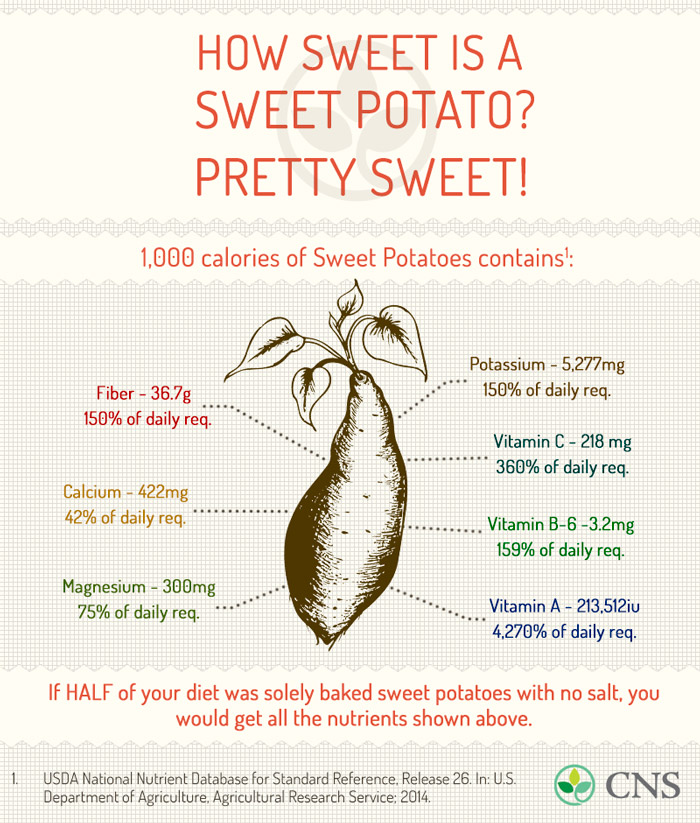
How Sweet is a Sweet Potato? Pretty Sweet!

Sweet potatoes are a super food that I have only recently come to appreciate. When preparing my lecture on heart disease epidemiology for ournew eCornell course, I found reports of several traditional cultures known for avoiding heart disease that subsist largely on this delicious tuber. In fact, a 1978 paper[1] cited a dietary survey finding that sweet potatoes supplied about 90% of total calorie intake in the traditional subsistence culture of the Papua New Guinea highlanders. 90%! Sinnett and Whyte write, “Indeed, non-tuberous vegetables accounted for less than 5% of the food consumed, while the intake of meat was negligible.” There was no evidence of malnutrition from this diet and no evidence for hypertensive heart disease.

Here are some facts to chew on. If HALF of your diet was solely baked sweet potatoes with no salt, you would get all the nutrients in the table. To top it off: you get all this in a package with a lower glycemic index than white potatoes and many grains[2].

Nutrients in 1000 calories of sweet potatoes (about 10)[3]

Percentage of daily requirements (2000kcal diet)*

* Nutrient amounts calculated from USDA, reference 3, using the average daily requirements listed onhttp://www.dsld.nlm.nih.gov/dsld/dailyvalue.jsp

http://nutritiondata.self.com/facts/vegetables-and-vegetable-products/2667/2

References

  1. Sinnett P, Whyte M. Lifestyle, health and disease: a comparison between Papua New Guinea and Australia. Med J Aust 1978;1:1-5.
  2. Willcox DC, Willcox BJ, Todoriki H, Suzuki M. The Okinawan diet: health implications of a low-calorie, nutrient-dense, antioxidant-rich dietary pattern low in glycemic load. Journal of the American College of Nutrition 2009;28 Suppl:500S-16S.
  3. USDA National Nutrient Database for Standard Reference, Release 26. In: U.S. Department of Agriculture, Agricultural Research Service; 2014.
Thomas M. Campbell, MD is executive director of the T. Colin Campbell Center for Nutrition Studies and a practicing, board-certified family physician at the University of Rochester. He is co-author of The China Study and author of the upcoming book, The Campbell Plan: The Simple Way to Lose Weight and Reverse Illness, Using The China Study’s Whole-Food, Plant-Based Diet.

A Health Disaster in the Making

In 2002, the Food and Nutrition Board (FNB) of the National Academy of Sciences (NAS) released their most recent recommended nutrient intakes.

Since 1943, the FNB has been telling us how much of each nutrient to consume, in the form of the Recommended Daily Allowances (RDAs). This Board, and its companion Dietary Guidelines Committee of the United States Department of Agriculture (USDA) that translates the FNB recommendations into practical food guides, create what is generally known as national nutrition policy. The influence and responsibility of these two panels is omnipotent and awesome. Numerous government-supported programs use these recommendations, including the school lunch program, the Women, Infants and Children (WIC) program, and Medicare-reimbursed meals for hospitals and nursing homes.

Having been a member of several diet and health policy-making expert panels over a 20-year period, until 1997, I harbored the naïve view that these panels were dedicated to the promotion of consumer health. I no longer believe this.

This report makes clear that the food and health practices that have brought us so much illness in recent decades will remain intact, perhaps even made worse. Two of three Americans are overweight and ‘adult-onset’ diabetes is now attacking our children. The long-time high rates of various cancers and cardiovascular diseases remain mostly impervious to change. We’re paying increasing amounts of money – lot’s more – and getting less. An even faster food nation awaits us, to paraphrase Eric Schlosser’s book.

In this most recent FNB report, we see some brand new recommendations, especially for the macronutrients (protein, carbohydrates, fat) that supply our calories. Instead of recommending nutrient intakes that are based on single RDA numbers as in past reports, this new report allows for ranges of intake that are said to “meet the body’s daily nutritional needs while minimizing the risk for chronic disease”. The main conclusions are highlighted in the executive summary and news release. “Adults should consume 45 to 65 percent of their total calories from carbohydrates, 20 to 35 percent from fat [up to 40% for children], and 10 to 35 percent from protein.” The report also says that we can consume up to 25% of our energy from added sugars found in sweets, pastries and soft drinks. Expressing optimal nutrient intakes as ranges is certainly more informative and realistic than were the single-number RDAs of past reports. But defining and setting these boundaries must be based on a careful and complete review of the evidence.

Let’s consider the case for protein, which symbolizes our preferences for food more than any other single nutrient group. The lower limit of 10% dietary protein is equivalent to the RDA of previous reports, first published in 1943. Indeed, this quantity is already above the theoretical requirements of almost all people. Professor Henry Sherman of Columbia University was largely instrumental in establishing this recommendation, based on a 1920 summary of about 100 subjects. He suggested that about 8% of dietary calories was enough but offered that for those “whose temperaments lean toward a higher protein intake”, a range of 10-15% might be in order.

However, because we practically worship protein-rich foods, the vast majority of us have decided to ‘pig out’ within the range of 11-22% dietary protein, with most of this extra protein coming from animal based foods. But we do so at considerable health risk, partly due to the excess protein itself and partly due to the kinds of foods that mainly provide such a high protein intake. Only a very few of us consume diets as high as 22% protein, generally for ‘pumping iron’.

Now, we are to understand the astounding conclusion that consuming diets as high as 35% protein(!) lies within a range of “minimizing the risk for chronic disease”. The disease-promoting implications of this new recommendation are staggering. There is voluminous evidence showing that consuming diets ‘only’ as high as 20-22% protein increases the risk of many serious diseases. But the FNB committee says that we can go to an even higher level of 35%, without ill effect.

Increasing animal-based protein consumption up to dietary levels well below 35% associates with higher blood cholesterol levels and more atherosclerotic plaque (even more than saturated fat), greater risk of cancer (caused by multiple mechanisms), greater bone loss of calcium and higher risk of osteoporosis, greater risk of Alzheimer’s disease, and greater formation of kidney stones, to name just a few chronic diseases that the FNB committee mysteriously ignores or claims to remain unaffected by this high protein intake. These ignored findings are not the results of a few isolated experiments. In most cases, they represent a summary of multiple studies, some of which are even many decades old.

This report makes other macronutrient recommendations that are equally troublesome. It is said, for example, that we can safely consume up to 25% of our daily energy as added sugars, meaning candies, soft drinks, sweetened food products and pastries, some products of which are also loaded with added fat. The committee acknowledges that obesity has become a health problem of great concern but then disingenuously blames ‘high carbohydrate’ diets for the problem. Like certain popular diet book authors, they err in this view because they fail to distinguish between the health benefits of complex carbohydrates (e.g., whole grain products), which were previously recommended, and the health problems of refined sugars and starches (e.g., sweets, pastries and refined flour pastas), which were never recommended by previous reports.

The FNB report also lifts the lid on dietary fat. Previous reports recommended keeping dietary fat under 30% but this recent report now says that we can go up to 35%, even up to 40% for children.

Groups who use this report will be encouraged to consume the same diet of sugar and starch type carbohydrates and high fat and animal-based protein foods now making us fat and fertilizing the growth of our chronic diseases. Admittedly, past recommendations have not stemmed the rising tide of chronic degenerative diseases during the past few decades. But these recommendations, themselves, were lukewarm, partly because of a perception of insufficient evidence and partly because of a timidity of confronting a growing food industry offering up a buffet of protein-rich, fat-rich, processed foods. We now have overwhelming evidence to show that a plant-based diet of whole foods, low in fat and protein and high in complex carbohydrates (but not in refined carbohydrates!), is associated with substantially lower rates of these diseases. Furthermore, we also now have substantial information on how these foods produce their biological benefits.

This report represents a backlash against emerging but convincing evidence that now terrifies the food and drug industry. However, it does its best to remedy this problem by cooking up a bunch of sweets for these industries. Corporate health will undoubtedly be enhanced but consumer health will undoubtedly be set back, perhaps for decades.

I take no comfort in discovering a very troubling corporate influence in the making of this report. For example, the Chair of the sub-committee responsible for setting the upper limits for these macronutrients departed the panel before its conclusion for an executive position with the world’s largest food company who will find these goodies especially tasty for their bottom line. His replacement was someone who openly acknowledges that he knows very little about nutrition, as this has not been his field. The FNB Chairman, who helped select panel members, is a well-known associate of the dairy industry. During his chairmanship of the companion Dietary Guidelines Committee, his industry ties regrettably became known only through court-enforced legal action. I also find it troubling that this report received funding from food and drug companies who will find its contents especially tasty.

I do not recall such egregious conflicts of interest during my tenure with such advisory panels. It is time that advisory panels and their parent organizations who develop diet and health policy take more responsibility of fully revealing all potential conflicts of interest. Further, I would urge that they consider disallowing researchers with serious conflicts from holding leadership positions on these panels. The public deserves far more than they are getting from this very important report.

Dr. T. Colin Campbell has been at the forefront of nutrition research for over forty years. His legacy, the China Project, has been acknowledged as the most comprehensive study of health and nutrition ever conducted. Dr. Campbell is the Jacob Gould Schurman Professor Emeritus of Nutritional Biochemistry at Cornell University. Dr. Campbell also serves as the President of the Board for the T. Colin Campbell Center for Nutrition Studies and is featured faculty in our highly acclaimed, Plant-Based Certificate and our online heart course, Nutrition for a Healthy Heart.

RDA’s: Time to Peel Back the Labels

RDA’s: Time to Peel Back the Labels

Every once in a while, when strolling through the grocery store with my wife, Karen, I get up the nerve to look at those nutrient profiles on the side of the package.

Even though I was recently on a National Academy of Sciences committee on food labeling, responsible for redesigning this information, I still wonder what all this really means. The Recommended Daily Allowances (RDAs) are the nutrient levels considered by governments and industry throughout the world to be desirable for good health. But how desirable are they really? Let’s see what’s beneath the label.

To begin with, the RDA is just what it says it is. It’s a recommended allowance; it’s not a minimum requirement. The underlying assumption is that if you consume exactly the RDA level for a specific nutrient, there is a very high (97-98%) probability that you will exceed your actual minimum requirement. In other words, to play it safe, the RDA represents a substantially higher intake than what you need.

Why then do so many people believe that they must consume an intake at least equal to or even higher than the RDA? This is because the food and vitamin supplement companies carefully coach us to believe in RDAs. For them, this idea makes money, and lots of it. It’s an easier “sell” to say that the nutrient content per serving of a company’s particular product comes closer to the RDA than that of their competitors.

The idea of RDAs started reasonably enough when a few folks began asking about the nutrient value of military rations during World War II. The decision was handed over to the Food and Nutrition Board of the National Academy of Sciences. Ever since, this authoritative body has stood at the helm of so-called “good health” by issuing their revised listings every five years. But let’s look at what these reports are actually saying. First, there is an RDA given for each nutrient, broken down according to age and sex. Each RDA represents the minimum intake for a “single” nutrient, along with an upward adjustment thrown in for good measure. While this presumably provides us with a “safety check,” no range is given with high and low numbers. This single bottom number, already higher than the minimum requirement, suggests to many, “the more, the better.”

Making Money from RDAs

Folks, it just ain’t so. Witness the recent beta carotene revelations. You may recall that this study was halted when scientists reported the death rate from lung cancer was 28% higher among the participants who had taken the massive doses of beta carotene and vitamin A than those who had taken a placebo, and the death rate from heart disease was l7% higher. At least in countries like the U.S., where gorging is often the norm and vitamin supplements are treated as medicine, we ought to be thinking more about nutrient excesses than deficiencies. Note especially vitamin labels boasting such claims as “high potency” or “super-stress” formula. This problem is compounded when we forget about good wholesome diets (of plant-based foods) where nature works wonders in her own way.

Another serious problem goes something like this. In the absence of adequate scientific information, scientists establish RDAs which tend to be biased in favor of conventional levels of intake. But what are these “conventional” intakes? It’s this: they are those intakes which characterize diets that are high in fat, low in fiber, and high in animal proteinthe very kind of diet which causes us so many problems. Thus, a tendency exists to keep RDAs for plant-based nutrients low, while keeping animal-based nutrients high.

Even when we know it’s questionable, we find a very strong tendency to maintain the status quo. Vitamin C, for example (only available in plants), is given an RDA of 60 mg/day even though considerable information suggests that levels around 200-300 mg/day are more beneficial. And beta carotene, obtained almost entirely from plants, doesn’t even have an RDA. Generally, beta carotene is viewed as only a part of the “real” vitamin A, called retinol, which is found only

in animal-based foods. Dietary fiber, another plant-based nutrient, is relegated to the same non-category as beta carotene, and is similarly deprived of an RDA status. When it comes time to hand out RDAs, plant-based nutrients are either not assigned one or are given an RDA biased toward the low side. To register the higher, more appropriate intakes would suggest eating considerably more fruits and vegetablesa tough thing to do for meat and potatoes folks.

Standing on Shaky Foundations

By contrast, RDAs for animal-based nutrients are characteristically biased upwards. To take but one example, the RDA for calcium (at 800-1200 mg/day) is considerably in excess of the much lower intakes that are adequate for those on a plant-based diet. Probably a more accurate figure, based on our China Project surveys, would be closer to 400-­600 mg/day. Especially in the case of calcium, the amount of the nutrient needed is influenced by the type of diet consumed. That is, a high-dairy diet brings along baggage in the form of extra protein. And this extra protein causes calcium to be lost; thus more is needed. Why not try cutting down on dairy products so you require less calcium? In this country, about 60-­70% (on average) of total calcium intake is provided by dairy products.

RDAs have for a long time provided the so-called bedrock for dietary recommendations, such as the Basic Four Food Group guide, despite their shaky foundations. Used for so many years as a “good” general nutrition message by the United States Department of Agriculture (USDA), the Basic Four Food Group guide was devised to ensure adequate intakes of certain nutrients, especially those which supported high intakes of animal-based foods. As a result, scientists were inclined to “discover” that vegetarian diets were deficient in some nutrientscalcium, “good quality” protein, “good quality” iron, riboflavinwhen they were actually being judged against the biased RDA standards.

Heeding Mother’s Advice

Even though I believe that RDAs have mostly been an albatross around the neck of sound nutrition education, they may possess some value in defining nutritional profiles of large populations. That is, nutrient reference standards, such as the RDAs, can give a rough idea of a nation’s comparative nutritional health. But even so, I still wonder what useful purpose is served when nutrient intakes of a population are judged by reference standards prejudiced in favor of a low-fiber, high animal protein and fat diet.

Of all the dietary recommendations, RDAs are the oldest. In my view, they have been problematic from the start. Fortunately, the USDA’s Basic Four Food Group guide, with its emphasis on RDA standards, is now virtually dead. Still more fortunate is that we are now getting the U.S. Dietary Guidelines and the USDA Diet Pyramid, which pay less heed to the RDAs and which give somewhat more emphasis to plant-based foods, although this emphasis is still preciously limited. And then there are the newer Mediterranean and Asian Diet Pyramids, produced by a prominent well-heeled consumer based agency, which give considerably more emphasis to plant-based foods. I’ll comment on these newer nutrition guidelineswhere they succeed and where they failin an upcoming issue.

Progress is painfully slow in this arena where Big Science, Big Politics, and Big Business tell us what to eat. I rather still like that old advice of our mothers and grandmothers: eat your vegetables!

References

Campbell, T.C., “More Is Not Necessarily Better.” Natural History, 90:12-16, 1981.

Kolata, Gina, Studies Find Beta Carotene, Taken by Millions, Can’t Forestall Cancer or Heart Disease, New York Times, Jan. 19, 1996.

T. Colin Campbell is the Director of the Cornell-Oxford-China Diet and Health Project. He was trained at Cornell (M.S., Ph.D.) and MIT (Research Associate) in nutrition, biochemistry, and toxicology. He presently holds the endowed chair of Jacob Gould Schurman Professor of Nutritional Bio-chemistry at Cornell University.

Dr. T. Colin Campbell has been at the forefront of nutrition research for over forty years. His legacy, the China Project, has been acknowledged as the most comprehensive study of health and nutrition ever conducted. Dr. Campbell is the Jacob Gould Schurman Professor Emeritus of Nutritional Biochemistry at Cornell University. Dr. Campbell also serves as the President of the Board for the T. Colin Campbell Center for Nutrition Studies and is featured faculty in our highly acclaimed, Plant-Based Certificate and our online heart course, Nutrition for a Healthy Heart.

Coconuts are for nuts only.

I Should Use Coconut Oil, Right?

By Anne Ledbetter, EdD November 21st, 2014 News21 Comments

A quick Internet search reveals that coconut oil must be a super healthy food. The health benefit claims include: increased endurance, reversing Alzheimer’s, stress relief, weight loss, bone strength, skin care and more. Of course coconut oil belongs on my healthful food shopping list, right? Not so fast.

Beyond what folks selling products want us to consider, some vegans and even plant-based foodies believe that using coconut oil has got to be healthy because after all, a coconut is a plant. In their natural unprocessed state coconuts, corn and olives are all plants. However, a serving of highly refined plant (even organic) oil is quite different than taking a bite of fleshy coconut meat, eating niblets of corn, or popping an olive in my mouth.

This explains why many science based, optimal health advocates such as Dr.’s T. Colin and Thomas M. Campbell, authors of The China Study use a more specific term a whole food, plant-based (WFPB) diet. WF takes the level of food processing into consideration. Dr. Caldwell Esselstyn Jr., author of Prevent and Reverse Heart Disease, advocates a no oil WFPB diet and lifestyle.

Dr. Esselstyn’s mantra is “NO OIL!” How can he be so emphatic? Could it be that vegetable oils have absolutely no: fiber, carbohydrates, protein, vitamins, minerals, or essential fats? Is it possible that a lot of calories and an abundance of saturated fat lurk in the fatty “healing elixir?” Maybe it’s because oil injures the endothelium, the innermost lining of the artery, the ‘gateway to vascular disease.’ Matthew Lederman MD, co-author of Keep It Simple Keep It Whole, strongly supports the no oil WFPB diet as well.

If interested in learning more about coconut oil, be sure to check out Dr. Ledermans’s article from our Plant Based Nutrition Certificate Program. Dr. Lederman describes medium chain fatty acids (MCFA’s) and “why vegetable oils are better used for lubricating vehicles and skin than consuming as food”.

Dr.’s Campbell, Esselstyn and Lederman are T. Colin Campbell Center for Nutrition Studies faculty.

Image Credit: Alex Masters / Flickr

No Whey! Man

No Whey, Man. I’ll Pass on the Protein Powder

By Guest Author November 7th, 2014 The Wheys of Dairy & Casein123 Comments

For the past fifteen years, I have been closely involved with the bodybuilding industry. I have an intimate understanding of how the industry operates. In a nutshell, it is sustained by the supplement companies that sponsor the athletes who represent them. This in turn inspires fans who admire the athletes to purchase the products they represent, thus creating a cycle that drives record sales and profits, all the while potentially harming the health of many involved in the industry later on down the line.

Two of my favorite professional bodybuilders, Nasser El Sonbaty and Mike Matarazzo, recently died in their forties, likely from diet-related health issues. In all probability, their deaths were a result of too much protein consumption, coupled with the use of performance enhancing substances day after day until their organs failed. Now they’re gone. This is not a rare occurrence in bodybuilding. Though bodybuilders exercise more than the average person, the rate of bodybuilders suffering from diet-related health problems is often more common than the general American public falling ill to diet-related diseases. Clearly, there is a problem that needs to be addressed.

If there is one thing in the sport of bodybuilding that is as common as weight training, it is the use of supplements. No supplement is more widely consumed than protein powder. The powders of choice among mainstream bodybuilders are whey and casein, which are proteins derived from cow’s milk. In fact, these are the substances of choice for most protein powder consumers worldwide.
Athletes from all walks of life embrace the consumption of excess protein under the assumption that more is better. Many companies (and entire industries) have gone to great lengths to convince the public that they need to seek out high protein foods and consume as much protein as possible, without any consideration of the health consequences that accompany excess consumption. The focus on consuming large amounts of protein is so engrained in our culture, there are often warnings given out by friends and relatives of those following a plant-based diet that protein will be hard to come by without consuming animal products. That is another way protein supplements squeeze their way into the diets of citizens everywhere, through the unwarranted fear that we won’t get enough of this specific nutrient, suggesting whey and casein as plausible aids in this quest.

Years ago, I learned from Dr. T. Colin Campbell’s book, written with his son, Dr. Thomas Campbell, The China Study, that casein has the ability to turn on and turn off cancer growth simply by adjusting the level of intake of that protein. This was determined through years of clinical trials, experiments, and tests, which yielded these results, and are outlined in detail in Dr. Campbell’s research. His findings show that when casein is consumed in large quantities, cancer cells increase in size, and when there is a cessation in consumption of casein, cancer tumor cells recede.[1] I later learned that elevated levels of protein can also cause kidney damage, liver problems, kidney stones, excess fat gain, contribute to the damaging of the lining of artery walls, lead to plaque build up in arteries, result in lethargy, diminish bone density, and cause a host of other health problems. If this is truly the case, as it has been revealed by Dr. Campbell and numerous other world renowned experts who came to the same conclusions through experimentation, observation, and scientific research, why are these products consumed at such high levels? With their direct correlations to increased risk of disease, why is casein, which has been linked to illnesses such as prostate cancer, more than any other protein, allowed to be sold in stores? Why are these products even produced? After all, who needs them, besides calves?

If we have special protein powders created from cow’s milk for human consumption, it would only make sense that it must be because our society sees a very high rate of protein deficiency. But, that isn’t the case at all. In fact, a protein deficiency is almost unheard of in America and only exists in someone who does not consume adequate calories. The reason this is so, is because of the macronutrient make-up of food. Food is only made up of proteins, fats, carbohydrates, and water (and sometimes alcohol). Some level of protein is present in all foods, and in significant quantities in specific types of foods such as beans and other legumes, nuts, seeds, leafy green vegetables, other vegetables and grains. The amount of protein required by the human body (5-10% of total calories per day) is relatively low in comparison to the other macronutrients. It is therefore impossible to be protein deficient when sufficient calories are consumed. This is how nature works. In reality, most people in developed countries, including those following a plant-based diet, eat too much protein, not the other way around.[2] We clearly don’t have a health or nutritional need for whey or casein protein powders, so why are they here, why are they so popular, so common, and why is their use so infrequently questioned?

Part of the answer lies in the world of bodybuilding and the magazines, books, websites, athletes, and other individuals that feed the industry. The community that I have been part of for so long is a key factor in keeping these antiquated ideas about protein alive. It is therefore my (and others’) mission to effectively dispel these myths by showing a healthier way to support fitness goals without the use of any substances that came from a cow’s udder. As a semi-retired bodybuilder and current health and wellness advocate and multi-sport athlete, I endorse a whole-food, plant-based diet for optimal results, even when bodybuilding. I aim to put the desire for elevated levels of protein to rest by showing how a relatively low protein, whole-food, plant-based diet can support all athletic endeavors effectively and efficiently. I have achieved great results as a plant-based athlete for the past two decades, and have sought to lead by example.

If health is your goal, clearly, your answer to cow-based protein powders should be, “No whey, man.” Let’s put this into perspective. If you had to buy a clearly labeled animal-derived fat powder and carbohydrate powder at the same time of purchase as a whey or casein protein powder, would you proceed with the purchase? Or would it seem so silly to get your required macronutrients from canisters of animal by-products, the cashier at the store would raise an eyebrow and question your sanity? Consider these questions the next time you think about buying powders made from cow secretions for proper nutrition. How about eating something from a garden instead? Not only is it a much healthier choice, but fresh produce is a lot more appetizing, too.

References

Campbell, T.C., Campbell, T.M. (2006). The China Study. Dallas, Texas: BenBella.
Do Vegetarians Get Enough Protein? (2014). Retrieved from (link).
Guest Author Robert Cheeke
Robert Cheeke, bestselling author of Vegan Bodybuilding & Fitness, and author of the new book, Shred It!, available on http://www.veganbodybuilding.com.
Related Posts:
Animal Protein as a CarcinogenAnimal Protein as a Carcinogen proteinProtein

The Collapse of Cardiology

By Caldwell B. Esselstyn, Jr., M.D.

January 17, 20007 — Recent weeks have witnessed a collapse of the drugs and technology which form the present back bone of cardiology’s assault on the coronary artery disease epidemic. Is this a dark shadow over our cardiac health or could it be a time to rejoice?
Pfizer, in late December 2006 announced its long hoped for block- buster new drug Torcetrapib was killing more people in its test run than were dying in the control group. Pfizer had spent 800 million in developing this drug to raise HDL, “good” cholesterol and had openly forecast it would reap billions for the company once it came into production. But the research trial was clear and unequivocal with its results. Among 15,000 patients, 82 died taking Torcetrapib and 51 died taking a standard drug to lower cholesterol Additionally the Torcetrapib group experienced a greater number of cardiac events such as angina, heart failure, and a need for angioplasty. The independent monitoring group advised Pfizer to halt the trial and they complied. The unfathomable mysteries of human metabolism could not tolerate the assault of this drug. It was making vascular disease worse not better.

The double whammy for cardiology also developed in the second half of 2006. Reports from Europe in September 2006 indicated that patients utilizing the new drug eluting stents were suddenly having heart attacks and some were dying. While the number was small (0.5%), it was disturbing to cardiologists and remains frightening for patients.

When an artery to the heart is severely narrowed and causing symptoms cardiologists insert a balloon tipped catheter to the area of blockage and expand the balloon to widen the constriction. The benefit of this angioplasty is lost in 50% of patients because of recurrent constriction in 6 months. Placing a metal scaffold or stent improves the results to only 10% to 20% recurrent narrowing. Starting in 2003, stents were coated with a drug which diminished the rate of recurrent blockage after angioplasty. However, it is essential to maintain patients on an anti clotting drug for 6-12 months to prevent the stent from developing a clot or thrombosis. It now appears that after stopping the anti-clotting drug 1 in 200 or 0.5%or 5,000 nationwide and 10,000 persons worldwide will have a heart attack and 50% of these will die when the stent fails. These results have so upset cardiologists and the Federal Drug Administration that a national conference was called in December 2006 to review this disturbing news. Watching intently and participating were the stent manufacturers Johnson and Johnson and Boston Scientific. Billions of dollars are at stake.

Following testimony, experts contend that for patients with uncomplicated disease the benefits of the drug-coated stents outweighs the risks. For patients with more advanced or complicated disease patterns the outlook is less clear and more research data is required. What is clear is that everyone feels it may be necessary to prolong the period requiring the anti-clotting drug: Plavix from months to years or indefinitely. However Plavix is not without complications. It promotes bleeding, which may mean a gastrointestinal hemorrhage as well as easy bruising. The most desperate situations occur when a patient taking Plavix must stop it for dental work, hip or other major surgery and colonoscopy. Will they have a heart attack or die from a stent clot when Plavix is stopped? This scenario has occurred and is continuously encountered. It is as if a therapy for one disease now is painting patients into a corner from which they can not escape when other illnesses require surgical therapy.

This Gordian knot has lead leading cardiologists to question stent therapy.

Dr. Eric Topol, a member of the conference panel stated, “There’s a much more liberal use of angioplasty and stenting than there needs to be.”

The head cardiologist at Kaiser Permanente, Dr. Calvin L. Weisberger added, “A large pool of angioplasties and by pass surgery are being done with out scientific evidence.”

The hard science, which seems not to be prominent in all these discussions is that it is not the major blockages which are treated by angioplasty and stents which account for heart attacks. The small unstable juvenile arterial plaques are prone to rupture and cause over 85% of heart attacks, and they are not treated by angioplasty or by-pass surgery. Then why do cardiologists treat the blockages unlikely to cause the heart attacks? There is a lingering belief that somehow the patient will be improved by widening the opening, and there is the unspoken force of money – huge guaranteed money from doing these procedures.

Then there is the harshest critic of all- scientific research. Study after study indicates for most patients undergoing angioplasties and stents, there is no increase in survival and no decrease in heart attacks.

Why might this be a time to rejoice? The morbidity, mortality, expense and transient benefits of a high technology approach toward the coronary disease epidemic, has failed. It is time to realize that the answer to a faulty lifestyle epidemic is not drugs and technology – it is lifestyle. The epidemiologic evidence that coronary artery disease does not exist in cultures consuming plant-based nutrition is robust and overwhelming. There is clear evidence that cultures which switch from a plant based culture to a western diet develop an epidemic of coronary heart disease. Lewis Kuller, Professor of Medicine at the University of Pittsburg School of Public Health, based on his 10 year cardiovascular health study states “all males 65 years of age or older who have been exposed to the traditional western diet have cardiovascular disease and should be treated as such.

This toxic diet with its burden of animal protein, dairy, processed oils, white flour, sugar, and excess saturated and trans fats and free radicals marinates in our bodies injuring our delicate cellular matrix with every bite at every meal. Science shows us how this occurs. We depend mightily on the capacity of our endothelial cells, which comprise the single cell layer lining our arteries, to manufacture nitric oxide. Nitric oxide is the strongest vasodilator in the body. It causes blood vessels to enlarge, prevents blood flow from being sticky or sluggish, and inhibits arterial plaque formation.

The brachial artery tourniquet test quantifies the endothelial responses. The test requires an ultrasound measure of the diameter of the brachial artery below the elbow before and after an upper arm tourniquet stops blood flow to the forearm for 5 minutes. Normally when the cuff is released and the brachial artery ultrasound measurement is repeated the artery dilates or widens. This occurs from a healthy out pouring of nitric oxide from the endothelium. When volunteers consume cornflakes their brachial artery tourniquet test is normal. If they consume sausage, olive oil, or saturated fat they fail the test. The ingested fat so injures the endothelium that it cannot produce nitric oxide. Regular consumption of the toxic western menu is a cardiovascular disaster. The time is long overdue to challenge the failure of drugs and technology to stop the coronary disease epidemic.

The natural next question is can patients who have severe coronary artery disease arrest and reverse this disease by consuming a totally plant based diet?

Dr. Dean Ornish and this author have investigated this question through scientific peer reviewed study. Dr. Ornish reported his results at one year and again at 5 years. This author reported results at 5 years, 12 years and most recently at 21 years in a book for the public, Prevent and Reverse Heart Disease, Avery /Penguin, February 2007. These studies indicate that fully compliant patients decrease the episodes of angina or eliminate them, decrease their cholesterol, decrease their weight, increase their exercise capacity, and arrest and selectively reverse their disease on follow up x-rays of the coronary arteries. Seeing these patients thrive beyond 20 years of initiating their plant-base therapy is the most powerful reason for wanting the cardiology community to embrace and utilize plant- based nutrition. There is no morbidity, mortality or added expense with plant-based nutrition and benefits endure and improve with the passage of time. Cardiologists say they doubt that patients will follow such a nutritional change. My experience in counseling hundreds of these patients indicates this concern is flatly not true. As a matter of fact, patients rejoice in the knowledge that they have become the locus of control over the disease that was destroying them and are distraught they were never told of this option by their cardiologist.

In summary, the dark shadow cast over cardiology, through failure of its miracle drug and the melt down of drug eluting stents with unforeseen clotting resulting in heart attacks and death should motivate us to look more closely at a proven therapy which is effective and endures and has the potential to eliminate the coronary heart disease epidemic, as well as other chronic western illness such as strokes, hypertension, adult onset diabetes, obesity, impotence and dementia.

Caldwell Esseltyn MD is a preventive cardiology consultant in the Department of General Surgery Cleveland Clinic Foundation, Cleveland, Ohio, and the author of the forthcoming, “Prevent and Reverse Heart Disease” due out February 1, 2007.