
Curcumin may provide an inexpensive, well-tolerated, and effective treatment for inflammatory bowel disease (IBD) such as Crohn’s and ulcerative colitis, recent research suggests. In this study, mice given an inflammatory agent that normally induces colitis were protected when curcumin was added to their diet five days beforehand. The mice receiving curcumin not only lost much less weight than the control animals, but when researchers checked their intestinal cell function, all the signs typical of colitis (mucosal ulceration, thickening of the intestinal wall, and the infiltration of inflammatory cells)were all much reduced. While the researchers are not yet sure exactly how curcumin achieves its protective effects, they think its benefits are the result of not only antioxidant activity, but also inhibition of a major cellular inflammatory agent called NF kappa-B. Plus, an important part of the good news reported in this study is the fact that although curcumin has been found to be safe at very large doses, this component of turmeric was effective at a concentration as low as 0.25 per cent—an amount easily supplied by simply enjoying turmeric in flavorful curries.
A Potent, Yet Safe Anti-Inflammatory
The volatile oil fraction of turmeric has demonstrated significant anti-inflammatory activity in a variety of experimental models. Even more potent than its volatile oil is the yellow or orange pigment of turmeric, which is called curcumin. Curcumin is thought to be the primary pharmacological agent in turmeric. In numerous studies, curcumin’s anti-inflammatory effects have been shown to be comparable to the potent drugs hydrocortisone and phenylbutazone as well as over-the-counter anti-inflammatory agents such as Motrin. Unlike the drugs, which are associated with significant toxic effects (ulcer formation, decreased white blood cell count, intestinal bleeding), curcumin produces no toxicity.
Key Health Benefits of Cayenne Pepper
 Key Health Benefits of Cayenne Pepper
• This herb is a great food for the circulatory system in that it feeds the necessary elements into the cell structure of the arteries, veins and capillaries so that these regain the elasticity of youth again, and the blood pressure adjusts itself to normal. It rebuilds the tissue in the stomach and heals the stomach and intestinal ulcers; in equalizing the blood circulation, it produces natural warmth in your body; and in stimulating the peristaltic motion of the intestines, it aids in assimilation and elimination.
• It regulates the flow of blood from the head to the feet so that the pressure is equalized; it influences the heart immediately, then gradually extends its effects to the arteries, capillaries, and nerves (the frequency of the pulse is not increased, but is given more vigor).
• Human circulation; it is warming; dilating; specific for varicose veins; equalizes the blood pressure in the arterial and venous system; actually equalizes blood pressure instantly.
• It is useful in alleviating allergies, muscle cramp, improving digestion, gives more pep and energy, and helps wound healing with minimal scar tissue.
• It is a counter-irritant; it brings blood to the surface and allows the toxins to be taken away.
 In an article reported on March 16, 2006 by Reuters, the main ingredient in Capsicum, capsaicin, was found to destroy prostate cancer cells. Here is what the article said,
“Capsaicin led 80 percent of human prostate cancer cells growing in mice to commit suicide in a process known as apoptosis, the researchers said. Prostate cancer tumors in mice fed capsaicin were about one-fifth the size of tumors in untreated mice, they reported in the journal Cancer Research. ‘Capsaicin had a profound anti-proliferative effect on human prostate cancer cells in culture,’ said Dr. Soren Lehmann of the Cedars-Sinai Medical Center and the University of California Los Angeles School of Medicine.”
Understanding Glyphosate Toxicity:

A high-clearance sprayer applies Roundup herbicide on glyphosate-resistant marestail in a Mississippi no-till cotton field. The application failed and the weeds survived.
Photo by AgStock Images
Monsanto’s Roundup Ready crops are engineered to be herbicide tolerant, specifically when sprayed with Roundup. Now that the World Health Organization’s cancer research arm has designated Roundup’s active ingredient, glyphosate, as “probably carcinogenic to humans,” consumers need to fully understand how the chemical works on plants and, in turn, impacts human health. For in-depth answers about glyphosate’s toxicity and more, we turned to molecular biologist and retired genetic engineer Thierry Vrain.
MOTHER: When and why did you start researching glyphosate?
Thierry Vrain: I went to graduate school in North Carolina in the 1970s, where I was trained as a soil biologist — a nematologist, to be precise. Nematodes are microscopic worms in the soil that feed on the roots of plants and cause considerable yield loss for many types of crops. In school, I learned about agriculture and the damage caused by all sorts of pests and pathogens, such as nematodes, insects, and fungal diseases. I learned to deal with those pests by sterilizing soil or spraying pesticides. Halfway through my career, it became obvious that perhaps we could intervene at the molecular level to make crops naturally resistant to pests, so I learned molecular biology and became a genetic engineer. When I became head of a molecular biology department, I took it as my responsibility to educate people and try to assuage their fears about genetic engineering.
I retired 12 years ago and started gardening as a serious hobby. After gaining that hands-on experience, I realized how much damage pesticides cause to the living environment of the soil. I learned all sorts of things that I wasn’t taught in graduate school. For example, I learned that not only pesticides, but also regular fertilizers damage communities of microorganisms in soil. I became “organic,” so to speak.
At this point, I started reading scientific research showing a problem with genetic engineering. Rats and mice fed genetically engineered, Roundup Ready grain were getting sick. At first I couldn’t figure it out. My knowledge of the engineering technology made it clear to me that this should be safe. As I explain in my TEDx talk, “The Gene Revolution, the Future of Agriculture,” I couldn’t understand why adding a gene from one species to another could be toxic because this DNA technology is used every day in many research labs around the world to create a variety of transgenic animals and plants, to study their biology, and to advance various fields of knowledge. Only two years ago did I realize that the problem lies not with genetic engineering technology itself, but with the herbicide that’s sprayed on all Roundup Ready crops. Again, I took it as my responsibility to educate people.
MOTHER: When was this herbicide invented, and for what purpose?
Vrain: Roundup is the herbicide in question, and its active ingredient is glyphosate. Glyphosate is a very small molecule, an analog of glycine, which is one of the 20 amino acids that make up all proteins of all living organisms. This molecule was invented in the 1950s and patented in 1964 by Stauffer Chemical Co. in the United States. Stauffer Chemical was in the business of selling products that could clean mineral deposits off industrial pipes and boilers. Think of your electric kettle at home. After boiling water repeatedly over the course of a few months, you can see whitish mineral deposits on the walls of your kettle. Industries that use boiling water all the time must chemically remove the deposits every so often. The deposits are called “scales,” and the chemicals that remove them are called “descaling agents.” Glyphosate was invented as a descaling agent because it binds to all sorts of minerals and makes them unreactive, stripping them from the pipes. In biology and chemistry, we call this type of agent a “chelator,” and the binding of minerals is called “chelating.”
Somebody promptly figured out that glyphosate kills all bacteria and plants, and that there’s a lot more money to be made using this chemical as an herbicide rather than as a descaling agent. That’s when the chemical corporation Monsanto bought the rights to the molecule and patented it in 1969 as a nonselective herbicide.
MOTHER: How does glyphosate’s chelating ability affect the way it interacts with plants?
Vrain: Unlike animals and humans, bacteria and plants make their own proteins because they’re capable of synthesizing all 20 amino acids required as the building blocks of proteins. Bacteria and plants make three complex amino acids (we call them “aromatic amino acids”) in a small biochemical pathway called the “Shikimate Pathway.” One of the enzymes of that pathway is called “EPSPS” for short. EPSPS is a protein with an atom of manganese that must be there for it to function properly.
As a descaling agent, glyphosate enters the bacterial or plant cells and steals the atom of manganese from the EPSPS enzyme, rendering it unable to synthesize aromatic amino acids. If some of these building blocks are missing, the bacteria and plants can’t synthesize the proteins, and they promptly die.
MOTHER: How heavily is glyphosate used in the United States?
Vrain: When molecular biology and genetic engineering technologies became mainstream in the 1980s, somebody figured out they could engineer agricultural crops to be glyphosate resistant. When we engineer crops to be glyphosate-resistant, farmers can spray them with the herbicide and they’ll survive, even while the unwanted surrounding plants — the weeds — ultimately perish.
A handful of major crops are now glyphosate-resistant. Developers have trademarked them as “Roundup Ready.” The technology has revolutionized weed management in industrial agriculture. In 2013, farmers in the United States used glyphosate-resistant soybeans on 93 percent of all planted soybean acreage, corn on 85 percent of all corn acreage, and cotton on 82 percent of all cotton acreage. These glyphosate-resistant crops are usually sprayed twice at the beginning of the crop cycle with three-fourths to 1-1⁄2 pounds (depending on plant height) per acre. In recent years, many species of weeds have adapted and become resistant, requiring higher and higher dosages of glyphosate to be killed.
The use of glyphosate for chemical drying of non-engineered grain and seed crops has also grown exponentially in the past 15 years. This is not widely known. Some farmers who grow grains and seeds (such as cereals, beans, sunflowers, and hemp) now commonly spray a formulation of glyphosate to kill their crops just before harvest. This process also kills any weeds that might have popped up during the growth of the crop. This is called “chemical drying” or “dessication.” It makes for a much easier harvest of grains and seeds.
MOTHER: What are the current allowable amounts of glyphosate in food and water, and how do they compare to the levels at which scientists are detecting harmful effects?
Vrain: We know very little about the residual amounts of glyphosate in food crops for human and animal consumption. Most other pesticides and herbicides are closely monitored by government agencies in Canada and the United States, but for some reason glyphosate residues have not been monitored closely. What we do know is that the legal levels allowed by the Environmental Protection Agency and Health Canada have increased significantly in the past few years — presumably to accommodate the new reality. The allowable levels are now well above parts per million (ppm). Every single crop has allowable levels: sugar at 10 ppm, soybean and canola at 20 ppm, cereals at 30 ppm, nongrass animal feed at 400 ppm. Residue levels that were once considered extreme are now seen as normal.
A large number of published scientific studies — mostly done outside the United States — show that as little as 1 ppm of glyphosate will kill almost all bacteria — particularly beneficial bacteria — in the gut of animals; that endocrine disruption starts at 0.5 ppm; and that even just a few ppm can cause oxidative stress, chronic inflammation, DNA damage, and many other disruptions in mammalian organ cells and tissues. Last year, the World Health Organization asked an international team of 17 senior toxicologists from 11 countries to review the status of several agricultural chemicals, including glyphosate. Their verdict regarding glyphosate’s toxicity was that the scientific literature contains enough convincing evidence to classify it as a probable carcinogen.
MOTHER: Monsanto, the company that owned the glyphosate patent, claims that humans can digest glyphosate in our food and water and it won’t accumulate in our bodies. Is this true?
Vrain: Recent scientific studies clearly show that glyphosate doesn’t degrade easily in soil or in humans and animals. A German study suggests that glyphosate accumulates in all organs (liver, kidneys, intestines, heart, lungs, bones, and so on) of animals and people eating food products made from Roundup Ready crops.
Monsanto and the North American government regulatory agencies have promoted glyphosate as the safest herbicide for 40 years. It was assumed at the time of its registration that it couldn’t affect animals because the Shikimate Pathway (where it impairs protein synthesis) is present in plants and bacteria but not in animals. However, the past 10 years have brought enormous progress in our understanding of the pre-eminent role of the microbiome in animal physiology. In humans, it turns out that the 100 trillion bacterial cells that live in our intestines — and that do contain the Shikimate Pathway — play an absolutely essential role in the health of most of our organs.
MOTHER: We were surprised to learn that glyphosate is also patented as an antibiotic. What are the effects this has on human health and the soil food web?
Vrain: We’ve known for decades that glyphosate is a powerful antibiotic, but it was only patented as one in 2010. I call glyphosate an antibiotic masquerading as an herbicide. Aside from its function as an endocrine disrupter and the multitude of other documented nefarious effects it has on human physiology, I think the most immediate concern about glyphosate’s toxicity is its damaging effect on the human microbiome.
I don’t remember seeing much research on the effects of glyphosate in the soil environment, other than the usual industry-sponsored (and reassuring) results. Plenty of anecdotal evidence, however, shows that damaging soil microbiology leads to slow desertification.
MOTHER: How do you recommend we move forward to prevent this toxic herbicide from causing any more damage?
Vrain: Roundup has become the most successful agricultural chemical in the past 40 years. It’s extremely useful in all kinds of weed-management applications. Because it was originally labeled as innocuous to humans and animals, Roundup has been heavily used, and it’s time to reconsider its place in the market. In light of glyphosate’s toxicity, we must strictly regulate the use of the herbicide Roundup, abandon chemical drying of grain and seed crops, and recall Roundup Ready technology.
How to Avoid Glyphosate
They Are Biocides, Not Pesticides
They Are Biocides, Not Pesticides — And They Are Creating an Ecocide
By Andrew Kimbrell, Executive Director, Center for Food Safety

This article was originally published on The Huffington Post, May 4, 2015.
“A single corn kernel coated with a neonicotinoid can kill a song bird.” As a long time environmental lawyer and campaigner, I should not have been stunned by that fact but I was. Shaking my head in dismay, I read on, “Even a tiny grain of wheat or canola treated with the …neonicotinoid… can fatally poison a bird.”
The report is from the American Bird Conservancy and the neonicotinoids referred to are a relatively new class of insecticides that have become the most commonly used in the world, with several hundred products approved for use in the U.S. These “neonics” are neurotoxins that paralyze and eventually kill their victim. My organization, Center for Food Safety, has been working hard to halt the use of these neonics through litigation, legislation, grassroots advocacy, and legal petitions to the Environmental Protection Agency. We are suing to address the well-publicized threat that neonics present to the survival of honey bees and wild bees. At the time we launched our legal actions, I did not even know about the song birds.
The anger-stirring realization that a song bird could be felled by a single seed and the prospect of bees being silenced forever brought me back to the words of Rachel Carson, written more than half a century ago in Silent Spring. “These… non selective chemicals have the power to kill every insect, the ‘good’ and the ‘bad,’ to still the songs of the birds and the leaping fish… they should not be called insecticides but biocides.” Through Carson’s crusade, biocides like DDT were eventually banned but new chemicals like neonicotinoids and other similar “systemic” insecticides/biocides have taken their place causing similar ecological havoc. Sadly, our regulatory agencies under the sway of the agrochemical industry have enabled this tragic and continuing environmental destruction.
I think it is long past due that we who work in the food and environmental movement adopt Carson’s nomenclature. Let’s not refer to pesticides, whether they are insecticides, herbicides or fungicides, by anything but their real name: biocides. Words do matter.
The “cide” ending in all these terms comes from the Latin caedare meaning “to kill.” Given that these chemicals are designed to kill that root word is accurate. But using the word pest-icide gives the impression that all these chemicals do is kill “pests,” whether insects, plant, or fungi pests. The neonicotinoids killing bees and song birds puts that delusion to rest. The bee is an insect but not a pest and the song bird is neither an insect nor a pest.
But Carson only referred to insecticides as biocides. Is it fair to put all pesticides, including herbicides and fungicides, in the same pejorative etymological category? Well, let’s look at Monsanto’s Roundup. It is the most widely used herbicide in the world because of the adoption of genetically engineered (GE) crops designed to tolerate the chemical. Is Roundup just a pesticide, a careful killer of just those “bad” plants called weeds that farmers wish to remove? Of course not. Roundup does so much more than kill plant pests. It wipes out beneficial plants of all sorts: food crops, fruits in the orchard, flowers in the garden, in fact anything that is green. Most of these are not pests or weeds. Among the beneficial plants it destroys is milkweed, on which monarch butterflies depend. The massive use of Roundup in the U.S. has destroyed so much milkweed that monarch butterflies are now at risk of extinction. Monarch butterflies are not pests or weeds.
Then there were the University of Pittsburgh researchers who a decade ago tested how Roundup might impact immature and mature frogs in ponds. This is how the researchers summarized their results: “The most striking result from the experiments was that a chemical designed to kill plants killed 98 percent of tad poles within three weeks and 79 percent of all frogs within one day.” That is very effective killing indeed, but of course frogs are not pests or weeds.Argentinian researchers using animal models then linked Roundup and its active ingredient glyphosate to cranial malformations and other birth defects long reported in the children of farm workers who were repeatedly exposed to the chemical. Infants are not pests or weeds. And then in March 2015, the World Health Organization’s (WHO’s) cancer authorities — the International Agency for Research on Cancer (IARC) — determined that glyphosate is “probably carcinogenic to humans” based on multiple lines of evidence: kidney, pancreatic and other tumors in glyphosate-treated test animals; epidemiology studies showing higher rates of cancer in farmers that used glyphosate; and research showing that glyphosate damages chromosomes, one mechanism by which cancer is induced.
So Roundup is a butterfly killer, a frog killer and potentially an infant and adult human killer. And it has numerous other untold victims, to be sure. None of these are pests or weeds. So let’s not continue to use misleading euphemisms. Roundup is not a pesticide or herbicide; it is a “biocide.”
And now to fungicides. Their use in agriculture in the U.S. has skyrocketed, almost doubling in the last seven years. Unfortunately, research on their ecological and human health impacts has not kept up with the exponential growth in the use of these chemicals. But there is growing evidence that many of these toxics kill beneficial soil life, disrupting essential soil ecosystems. They are also increasingly becoming a water pollution problem, threatening aquatic life. Research has also pointed to concerning synergistic effects when used in tandem with other pesticides – delivering an even more toxic cocktail to bees and other beneficial insects exposed to the chemicals. Past studies indicate that 90 percent of fungicides are carcinogenic in animal models. To add insult to injury, they are also suspected of increasing obesity, especially in children. These health impacts remind us of yet another Carson insight: “Man is a part of nature and his war against nature is inevitably a war against himself.”
Overall, let’s contemplate what these biocides are bringing us: vast areas of this country stripped of all vegetation save for monocultured GE crops, devoid of flowers, bees, butterflies and song birds, with contaminated rivers and streams with little or no insect life, and fish and frogs and other aquatic life dead or deformed. Then there are the birth defects and cancers in our own children. What is the word that would encompass the result of our usingnearly a billion pounds of biocides each year? I would suggest it is nothing short of ecocide.
ANDREW KIMBRELL
ANDREW KIMBRELL’S BLOG
PUBLICATIONS
SPEAKING ENGAGEMENTS
FILM APPEARANCES
INTERVIEWS
Meat Causes Cancer, Says World Health Organization


After significant investigation of more than 40 years of research, the World Health Organization’s research team has classified meat as carcinogenic. This includes both red meat and processed meat, though processed meat was classified as a more certain risk. The research was published in the British Medical Association’s journal, Lancet.
The WHO’s International Agency for Research on Cancer (IARC) investigated volumes of research on both processed meats and red meats. The IARC announced they found the prevailing research was strong enough to classify processed meat as a Group 1 carcinogen – the most certain classification. This means that the research was strong enough to identify processed meats as “carcinogenic to humans.”
This puts processed meat in the same category given to tobacco and asbestos.
According to the WHO, this classification comes as a result of a series of studies that show that processed meats cause cancer. These studies include large-scale human population studies as well as clinical studies.
11 Nutritious Benefits of Eating Broccoli

Broccoli is one of those staple vegetables we were force-fed as children but continue to eat as adults. While those little trees aren’t much to look at, they pack a big punch of nutritional benefits.
To inspire you to get a forkful of the bushy vegetable into your mouth, here are 11 ways broccoli can boost your health!
1. Provides a Great Source of Fiber
When our parents told us to eat our vegetables, they kind of had a point!
With 2.6 grams of fiber per cup, broccoli is a great source of fiber whether you eat it raw, cook it, steam it, or add it into a casserole. Fiber can help aid your digestive system. This will keep your system regular and free of bathroom issues, which we’d all like to avoid. Steamed broccoli can bind together with bile acids in your digestive tract, making it easier to relieve yourself.
Additionally, a high-fiber diet has many benefits beyond the bathroom. A high-fiber diet has been shown to help reduce your risk of stroke, hypertension, and heart disease!
2. Helps Lower Cholesterol
Broccoli’s amount of fiber may be great for our bowel movements, but it can be celebrated for more than that. Because broccoli is an invaluable source of soluble fiber, the vegetable can help lower cholesterol, especially when prepared by steaming it.
3. May Reduce Allergies
Broccoli won’t stop you from contracting the common cold, but it can potentially stop you from sneezing fits due to allergies.
One study found that broccoli, which is rich in sulforaphane, could decrease people’s nasal allergic responses to diesel exhaust particles. The superfood may not totally erase your allergies, but it can potentially diminish their effects. That means you’ll sneeze less and need to carry fewer tissues.
4. Helps Prevent Cancer
Eating a high volume of cruciferous vegetables such as broccoli has been associated with a lower risk of lung and colon cancer, which are two reasons you should be adding broccoli to your dinner a few times a week. Sulforaphane, the sulfur-containing compound that gives broccoli its bitter taste, is largely credited for the vegetable’s ability to fight the disease.
Studies show that women who ate more than five servings of cruciferous vegetables per week had a lower risk of lung cancer. Research has also found that women who eat a lot of cruciferous vegetables have a lower risk of being diagnosed with colon cancer.
Another study showed a link between consuming cruciferous vegetables and a lower risk of breast cancer. While the research speaks for itself, more studies are needed to establish a concrete link between a lower cancer risk and broccoli consumption — as the results may also be due to a total increase in fiber.
5. Contributes to Healthy Bone Density
Broccoli has a considerable amount of calcium, which, when consumed, can contribute to a healthier bone density and even potentially prevent osteoporosis.
A low bone density can cause your bones to become weak, which allows bone breaks to happen more easily. One cup of broccoli also contains over 100 percent of your daily need of vitamin K, which can improve your bone strength.
6. Can Improve Vitamin D Deficiency
Vitamin D deficiency is a big problem, even in highly developed nations like the United States.
Although broccoli doesn’t contain a high amount of vitamin D itself, it can help offset the effects of taking large supplemental doses of vitamin D. Broccoli’s unusually strong combination of both vitamin A and vitamin K can help keep our vitamin D metabolism in balance. So if you’re taking any vitamin D supplements, be sure to add broccoli to your diet.
7. Better Digestion
Broccoli’s high concentration of natural fiber enables the vegetable to help prevent constipation and maintain a healthy digestive tract. The high fiber content is also helpful for promoting regularity in the digestive system, which is important because it allows toxins to depart the body via your stool.
8. Can Help You Look Younger
If you’ve noticed that the elements of the outdoors, and just life in general, have been taking a toll on your skin, you might want to consider adding more broccoli to your diet.
Broccoli contains many antioxidants, including vitamin C. When eaten in its natural form (as in, from a fruit or vegetable rather than from a supplement), vitamin C can help fight skin damage caused by the sun and pollution. It can also fight against wrinkles and help improve your overall skin texture.
9. Can Reduce Inflammation
Since broccoli is a rich source of kaempferol and isothiocyanates, it can reduce any allergy-related inflammation. The green-topped tree also has a high amount of omega-3 fatty acids, which are helpful in preventing inflammation.
10. Boosts Heart Health
Not only can broccoli reduce your cholesterol, it can aid your heart health by promoting blood vessel strength.
Sulforaphane, found in broccoli, can also help prevent or reverse damage to your blood vessel lining. One study found that broccoli’s vitamin B complex content can help regulate, or even reverse, excessive homocysteine. Homocysteine is an amino acid that typically builds up in your body after eating red meat, and is a marker for inflammation. Since homocysteine can increase your chances of developing coronary artery disease, adding broccoli to your diet could prevent your heart health from failing.
11. It’s Delicious!
As far as vegetables go, broccoli is quite tasty and can be cooked and consumed in a variety of ways. Whether you eat it raw over a salad, or steam it and include it as a side to your main dish, broccoli is a tasty contribution that also contributes to your overall health. Add some broccoli to your breakfast omelette, or add it as a side to your next dinner.
Erin Kelly
The Best Thing You Can Do for the Planet
How is it possible that the drastic spike in human population is not the biggest problem for the environment? Human population has increased, that’s true, but animal agriculture has exploded. There are now 70 billion farmed animals on this planet.
This clip from the documentary Cowspiracy explores human consumption and animal consumption to determine their impact on resources. While the seven billion humans on earth do consume large quantities of food and water, cows alone (1.5 billion) drink over eight times more water and eat over six times more food. This massive quantity of resources are used just so that humans can eat meat from cows.
Environmental organizations not addressing this is like health organizations trying to stop lung cancer without addressing cigarette smoking.
Transitioning to a plant-based diet doesn’t just benefit personal health, it also vastly improves the state of the planet and the people living on it.
ABOUT THE AUTHOR
Julia Helms is an editorial intern at Forks Over Knives. She is a student at New York University earning her degree in Global Public Health and Communications. After being diagnosed with type 1 diabetes, she transferred from the Fashion Institute of Technology to NYU to pursue a career in public health, concentrating on plant-based nutrition as a proactive form of disease prevention.
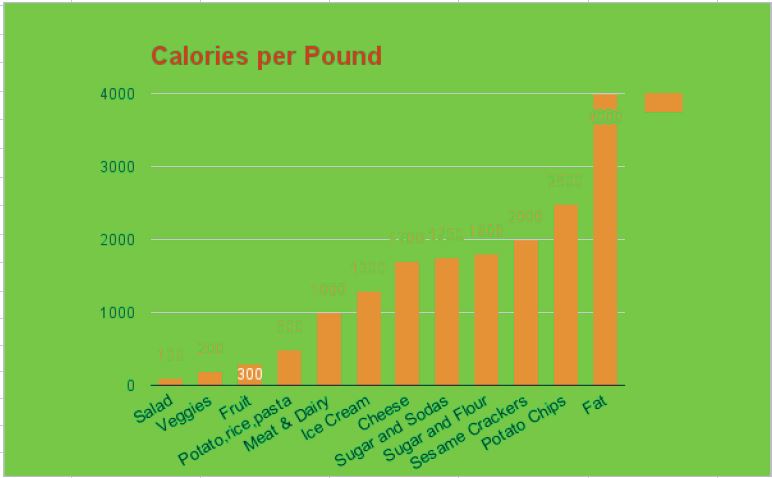
Calories per Pound
Look at the following chart. Plant based foods are all 500 Calories a pound or less. Animal based foods are all 1000 calories per pound or greater. So those who eat more plant based foods are lighter while those who eat more animal based foods are heavier.
Plant fats (oil) and animal fat (saturated) are both at the highest levels of caloric content so avoid both to stay or get slim.
For those who are interested, wine fits in at a cool 400 calories per pound. (3 x 5 ounce drinks)

 The Way To Eat