EP = a2 Has Killed More People than E=mc2

90+ How I Got There!

It’s been said Einstein’s E=mc2 (energy=mass x C speed of light squared) is the world’s most important scientific equation. Unfortunately it created the atomic bomb that killed thousands in World War II. But I believe my equation EP = a2 (extra pounds = atherosclerosis squared) is the world’s important medical equation. Regrettably, it’s killing more millions every year than E=mc2.Think again if you believe this is exaggerated.

Consider human obesity. Nothing, including the thousands of books on weight loss and diet, has been able to stop the epidemic of obesity which gets worse world-wide every year.

Nor does anyone have the solution to the problem of increasing numbers of people developing Type 2 diabetes. The U.S Centers for Disease Control and Prevention reports that one in 13 North Americans have diabetes. And one in four over the age of 65 suffer from this disease.

Then there are an estimated 14 million people in North America who don’t even know they have diabetes!! And millions more have prediabetes, just one step away from diabetes and its complications. All these figures increase every year.

So how does this combination kill? It’s because EP (extra pounds) = a2 (atherosclerosis), causes the rust that collects in all of our arteries as we age. We have known for years that people who are obese or have diabetes or both always develop more of this deadly rust that is composed of fatty deposits and cholesterol.

The deadly trio of obesity, diabetes and heart attack will eventually bring our health care system to its knees. Years ago this scenario was rare. More people died from infection. Now, since we live longer, the Gifford-Jones law has a major effect on longevity with the development of degenerative diseases. Gifford-Jones law states that one disease often leads to another, and another. The best example is that obesity leads to Type 2 diabetes and 50 percent of diabetics die of a heart attack due to atherosclerosis.

The problem isn’t complicated. If all the toilets in the country stopped flushing due to plugged pipes, civilization as we know it would quickly end. If the organs of our body lack oxygenated blood due to plugged arteries, our own lives on this planet end.

It’s been said that you can whip a tired horse only so long before it drops. Extra pounds similarly put tremendous stress on the pancreas. It eventually collapses and stops producing insulin.

When I graduated from The Harvard Medical School 65 years ago only 5 percent of people had Type 2 diabetes and 95 percent was due to genetics. Now, 95 percent develop Type 2 diabetes (better called lifestyle diabetes) due to obesity. And obese children usually become obese adults. This means they face the increased risk of blindness, kidney failure, leg amputation and heart attack.

Atherosclerosis is therefore the ultimate destroyer, gradually decreasing the amount of oxygenated blood and other nutrients that are necessary for all organs. Just as a car cannot run without gas the pancreas and other organs falter without oxygen.

So what is going to happen in the future? The answer is that EP=a2 will continue to kill more than Einstein’s equation. The blunt truth is that only draconian measures by government and citizens will stem the epidemic of obesity and Type 2 diabetes. Hell will freeze over before that happens.

But there is a simple, natural way to put a dent in the progress of the nation’s number one killer, heart attack. Research shows that high concentrations of vitamin C and lysine, now available as Medi-C Plus in Health Food Stores, can reverse atherosclerosis. It’s a revolutionary discovery that deserves the Nobel Prize. But it’s a national tragedy that this research is collecting dust and is being ignored by the medical establishment, particularly cardiologists who should be aware of it.

Medical Care Main Cause of Death

90+ How I Got There!

Hippocrates, the father of medicine, may be rolling over in his grave. Why? He preached “First, do no harm”. I recently read a report in the Journal of Molecular Medicine called Death by Medicine. It’s the most damning medical report card ever issued. It claims huge numbers of patients are being injured and killed by conventional medicine. There’s also a big surprise there.

A huge, meticulous study concluded that every year in the U.S conventional medicine kills 800,000 patients. Compare this figure to 700,000 that die of heart disease and 500,000 from cancer.

The report claims that 7.5 million medical and surgical procedures are unnecessary. Another 8.9 million patients are admitted needlessly to hospital and 2.2 million patients suffer adverse reactions to prescription drugs. The cost of this treatment? 282 billion dollars.

It’s appalling that every year 20 million people are treated with antibiotics for viral infections. But viral infections are not affected by antibiotics, only infections caused by bacteria!

The survey authors say past studies have concentrated on individual medical care rather than the big picture. They show that, during a 10 year period, 50 percent of the U.S. population will receive unnecessary medical care. During this time medical care will kill 7.8 million people. This is more than all the casualties from all the wars fought by the U.S. in its entire history!

The Journal of the American Medical Association adds that one million patients are injured annually in the U.S and that 280,000 die due to these injuries. Compare this to 45,000 killed in car accidents.

Another prestigious publication, The New England Journal of Medicine, states that one in four patients admitted to hospital suffers a medical error. The majority of these mistakes involve drugs for depression, painkillers such as non-steroidal anti-inflammatory and cardiovascular drugs.

At this point I wouldn’t blame readers asking, “What the hell is going on? Isn’t medicine supposed to save lives, not make it the number one killer?” So why is it happening? Some problems are due to tired doctors and nurses. Or the failure to use only specially trained doctors in intensive care units. Or because doctors and hospitals fail to report complications for fear of litigation. The list is as long as your arm.

The authors conclude with a shocking indictment that conventional medical treatment is the main cause of death in the United States! In fact, they believe most of the figures are under-reported and the death toll is equal to six jumbo jets crashing every day in the U.S.

The survey covers problems that I’ve reported for years. That young children taking Ritalin are being programmed for a life on drugs. That big pharma has spent 2.5 billion dollars claiming it’s educating the public while increasing its own bottom line. That the public is misled and programmed to illness by nightly TV diagnoses.

Dr. John Goffman, an expert on radiation, warns that in the future 75 percent of cancers will be the result of excessive radiation from X-rays, CT scans, mammography and fluoroscopy. He reports that an X-ray of the chest results in 2MREM of radiation. But an angiogram to detect coronary disease results in 460 to 1580 MREM!

Since this report is devastating, what should medical consumers do to protect themselves? Look on it as a big wakeup call, get smart and don’t become one of these statistics. Never believe that even minor surgery is risk free. If hospitalized, understand that the sooner you leave, the safer you will be. Be extremely cautious about radiation. Don’t take a painkiller for every ache and pain. There’s no free lunch with medication. “Pillitis” is killing people.

Above all else, take the least number of prescription drugs as they all have unintended consequences. Remember what I have stressed so often in my columns. It’s prudent to try natural remedies first before prescription medication. Why? Because there are no dead bodies due to natural remedies.

So what is the big surprise? The report was published in 2005! Today we have more drugs, greater exposure to radiation, more invasive procedures, still questionable use of antibiotics, etc. etc.

Will we ever learn from history?

Dr Gifford Jones MD

Engine 2 Diet Oil-Free Dressing

Engine 2 Diet Oil-Free Dressing

I know the name doesn’t really say much about this salad dressing, but you’ll have to trust me on this one, it is amazing! I’ve adapted this from the Engine 2 Diet’s “E2 Basics Dressing” (an even more anemic title than mine), and I make sure we always have a good supply on hand. I really don’t spend much time making this – it takes about 5 minutes to throw together and makes enough to last a week or so.

I’ve been trying to limit the amount of oil in my diet lately and the discovery of this dressing has made it surprisingly easy and delicious. I eat a huge salad of mixed greens every day and adding this dressing turns a simple salad into a nutritional powerhouse. I really like using Bragg’s Liquid Aminos as opposed to tamari or soy sauce. The flavor is great, there is no added sodium or preservatives, and it contains 16 essential and non-essential amino acids, the building blocks of protein!

Forget the name, go ahead and give this super easy dressing a try and let me know how much you love it!

6 Tbsp nutritional yeast
3 Tbsp tamari or Bragg’s Liquid Aminos
3 Tbsp Dijon mustard
3 Tbsp balsamic vinegar
3 Tbsp apple cider vinegar
6 Tbsp lemon or lime juice
3 Tbsp maple syrup or agave nectar
3 tsp vegetarian Worcestershire sauce
2 Tbsp flaxseed meal
1/4 cup cold water

Combine all ingredients in blender and mix well. Store in airtight container in the refrigerator.

Nutrition
Servings: 8
Per serving: 63 calories (12 from fat), 1.3g total fat, 0g trans fat, 0mg cholesterol, 180mg sodium, 9.7g total carbohydrate (2.8g dietary fiber, 5.8g sugar), 4.4g protein, 0% vitamin A, 9% vitamin C, 2% calcium, 10% Iron

  • Good Points: Low in saturated fat, no cholesterol, high in dietary fiber, iron, manganese, niacin, pantothenic acid, phosphorus, potassium, riboflavin, selenium, thiamin, vitamin B6, vitamin C, and zinc

Zesty Tahini Oil-Free Dressing

zesty-tahini-oil-free-dressing

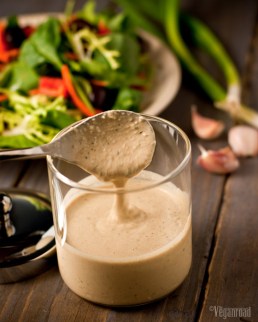
We have been trying a number of oil-free dressings lately and this one is definitely the best so far. It’s ridiculously simple, truly creamy, and just explodes with flavor. The recipe below makes enough for a few large salads but you may find yourself doubling it and using it every day (or is that just me?).

Try this and see if you don’t find yourself thinking about it all day…

1 clove garlic, crushed
4 scallions, diced
6 Tbsp sesame tahini
4 Tbsp apple cider vinegar
4 Tbsp lemon juice
4 Tbsp water
1/2 tsp salt
Fresh cracked black pepper to taste

Combine all ingredients in a food processor and blend until smooth and creamy. You may need to add a little water to reach your desired consistency, keeping in mind it will thicken in the fridge.

Nutrition
Servings: 6
Per serving: 109 calories (82 from fat), 9.1g total fat, 1.3g saturated fat, 0mg cholesterol, 236mg sodium, 2.7g total carbohydrate (0.8g dietary fiber, 0g sugar), 2.8g protein, 2% vitamin A, 11% vitamin C, 1% calcium, 6% Iron

  • Good Points: No cholesterol, low in sugar, high in vitamin C and iron

Galactose metabolism and ovarian toxicity.

Author information

  • 1Center for Women’s Health, Cedars-Sinai Burns and Allen Research Institute, Cedars-Sinai Medical Center/University of California Los Angeles, School of Medicine, 8700 Beverly Boulevard, Los Angeles, CA 90048, USA.

Abstract

Galactose is an energy-providing nutrient and also a necessary basic substrate for the biosynthesis of many macromolecules in the body. Metabolic pathways for galactose are important not only for the provision of these pathways but also for the prevention of galactose and galactose metabolite accumulation. Problems with galactose metabolism can cause a variety of clinical manifestations in animals and humans. It has been found that the mammalian ovary is particularly susceptible to damage from the accumulation of galactose and galactose metabolites. The galactose metabolites Gal-1-P, galactitol, and UDPgal are all considered to be important in this toxicity and proposed mechanisms include interference with ovarian apoptosis and gonadotrophin signaling. This review addresses the most recent scientific findings regarding the possible mechanisms of galactose-induced ovarian toxicity and also the possible protective role of hormonal and antioxidant therapy. In addition, the available epidemiologic and scientific evidence linking galactose intake with risk of ovarian cancer is discussed.

Milk and lactose intakes and ovarian cancer

Milk and lactose intakes and ovarian cancer risk in the Swedish Mammography Cohort1,2,3

  1. Susanna C Larsson,
  2. Leif Bergkvist, and
  3. Alicja Wolk

+Author Affiliations


  1. 1From the Division of Nutritional Epidemiology, The National Institute of Environmental Medicine, Karolinska Institutet, Stockholm (SCL and AW), and the Department of Surgery and the Center for Clinical Research, Uppsala University, Central Hospital, Västerås, Sweden (LB)

Abstract

Background: High intakes of dairy products and of the milk sugar lactose have been hypothesized to increase ovarian cancer risk, but prospective data are scarce.

Objective: We examined the association between intakes of dairy products and lactose and the risk of total epithelial ovarian cancer and its subtypes.

Design: This was a prospective population-based cohort study of 61 084 women aged 38–76 y who were enrolled in the Swedish Mammography Cohort. Diet was assessed in 1987–1990 with the use of a self-administered food-frequency questionnaire. During an average follow-up of 13.5 y, 266 women were diagnosed with invasive epithelial ovarian cancer; 125 of those women had serous ovarian cancer.

Results: After adjustment for potential confounders, women who consumed ≥4 servings of total dairy products/d had a risk of serous ovarian cancer (rate ratio: 2.0; 95% CI: 1.1, 3.7; P for trend = 0.06) twice that of women who consumed <2 servings/d. No significant association was found for other subtypes of ovarian cancer. Milk was the dairy product with the strongest positive association with serous ovarian cancer (rate ratio comparing consuming ≥2 glasses milk/d with consuming milk never or seldom: 2.0; 95% CI: 1.1, 3.7; P for trend = 0.04). We observed a positive association between lactose intake and serous ovarian cancer risk (P for trend = 0.006).

Conclusions: Our data indicate that high intakes of lactose and dairy products, particularly milk, are associated with an increased risk of serous ovarian cancer but not of other subtypes of ovarian cancer. Future studies should consider ovarian cancer subtypes separately.

Statin Use Promotes Diabetes and Obesity

Statins promote diabetes and obesity, according to a study published in the Journal of General Internal Medicine. Researchers monitored new cases of diabetes or diabetes complications and overweight/obesity rates in 25,970 patients. Those on statins had higher rates for diabetes, diabetes complications, and weight-gain when compared to those who do not take statins. The higher risk increased incrementally with higher dosages.

Preventing Skin Cancer From the Inside Out

Preventing Skin Cancer From the Inside Out
LATEST NUTRITION VIDEO

Preventing Skin Cancer From the Inside Out

Eating antioxidant-rich foods can bolster skin protection and reduce sunburn redness by 40%, whereas alcohol can dramatically drop the level of antioxidants in the skin within 8 minutes of consumption.

10 Foods High in Vitamin E

Why You Need Vitamin E

American Optometric Association

Lutein & Zeaxanthin

BroccoliLutein (LOO-teen) and zeaxanthin are important nutrients found in green leafy vegetables as well as other foods such as eggs. Many studies have shown that lutein and zeaxanthin reduce the risk of chronic eye diseases, including age-related macular degeneration (AMD) and cataracts.

AMD and cataract incidence are growing. Worldwide, more than 25 million people are affected by age-related macular degeneration and the formation of cataracts. AMD is the leading cause of blindness in people over age 55 in the Western world and the incidence is expected to triple by 2025.

Benefits to Eye Health

Lutein and zeaxanthin are carotenoids that filter harmful high-energy blue wavelengths of light and act as antioxidants in the eye, helping protect and maintain healthy cells. Of the 600 carotenoids found in nature, only two are deposited in high quantities in the retina (macula) of the eye: lutein and zeaxanthin. The quantity of lutein and zeaxanthin in the macular region of the retina can be measured as macular pigment optical density (MPOD). Recently, MPOD has become a useful biomarker for not only predicting disease but also visual function. Unfortunately, the human body does not synthesize the lutein and zeaxanthin it needs, which is the reason why green vegetables are essential to good nutrition. Daily intake of lutein and zeaxanthin through diet, nutritional supplements, or fortified foods and beverages is important for the maintenance of good eye health.

Lutein, Zeaxanthin and Cataracts

The primary function of the crystalline lens (or natural lens in the eye) is to collect and focus light on the retina. To properly provide this function throughout life, the lens must remain clear. Oxidation of the lens is a major cause of cataracts, which cloud the lens. As antioxidant nutrients neutralize free radicals (unstable molecules) associated with oxidative stress and retinal damage, lutein and zeaxanthin likely play a role in cataract prevention. In fact, a recent study demonstrated that higher dietary intakes of lutein and zeaxanthin and vitamin E was associated with a significantly decreased risk of cataract formation.

Lutein, Zeaxanthin and Age-Related Macular Degeneration

Much evidence supports the role of lutein and zeaxanthin in reducing the risk of AMD. In fact, The National Eye Institute presently is conducting a second large human clinical trial, Age-Related Eye Disease Study (AREDS2), to confirm whether supplements containing 10 mg a day of lutein and 2 mg of zeaxanthin per day affect the risk of developing AMD. Beyond reducing the risk of developing eye disease, separate studies have shown that lutein and zeaxanthin improve visual performance in AMD patients, cataract patients and individuals with good health.

Daily Intake*

Foods with lutein and zeaxanthin
Discover great recipes rich in Lutein

The USDA Nutrient Database offers comprehensive
information on raw and prepared foods.

Although there is no recommended daily intake for lutein and zeaxanthin, most recent studies show a health benefit for lutein supplementation at 10 mg/day and zeaxanthin  supplementation at 2 mg/day.

FOOD SOURCES

Most Western diets are low in lutein and zeaxanthin, which can be found in spinach, corn, broccoli and eggs. The following table lists foods known to be high in lutein and zeaxanthin. If you are not getting enough lutein and zeaxanthin through diet alone, consider adding supplements to your daily routine.

REFERENCES

*At this time, the AOA is unaware of any studies that have examined interactions between medications and lutein and zeaxanthin. The AOA also is not aware of any adverse health reports from interactions between medications and lutein and zeaxanthin. However, the AOA recommends consulting with a health care professional before beginning any supplementation regiment.