
 |
||||||||||||||||||||
|
||||||||||||||||||||
|
Category: Health
Related to health issues



 2013 John McDougall All Rights Reserved
McDougall Breaking News
NEJM Study Promotes Olive Oil and Dismisses Low-fat Diet
Your friends are reading today (February 26, 2013) The New England Journal of Medicine article about how adding olive oil and nuts to their usual diet will reduce their risk of heart attacks by 30 percent. This article has also told them that a low-fat diet fails to help (again). Stroke was the only problem where the tested Mediterranean diet made a real difference. The diet had no effect on heart attacks or death rates overall. The popularity of this message proves once again that “people love to hear good news about their bad habits.” They are reassured that simply by adding more olive oil and nuts you will improve your health…cutting out the brie and beef stroganoff are secondary thoughts.
The article begins by saying, “The traditional Mediterranean diet is characterized by a high intake of olive oil, fruit, nuts, vegetables, and cereals; a moderate intake of fish and poultry; a low intake of dairy products, red meat, processed meats, and sweets; and wine in moderation, consumed with meals.” Of course, this diet is an improvement over the usual fare consumed in the US and Europe, and that is why benefits were seen. The study lasted five years and involved about 7,447 people, ages 55 to 80, in Spain.
There was no reason to say the low-fat diet is a failure based on this research, because participants in the “low-fat” group made no real change in their diets. In the “low-fat” group, total fat consumption decreased insignificantly from 39 to 37 percent. Why was so little effort placed on teaching and then testing a really healthy low-fat diet like mine (the McDougall Diet is 7 percent fat), and then comparing it with the Mediterranean diet? There was no financial interest in pursuing this end. The vested interest was in selling olive oil and nuts. Two companies supplied the olive oil (Hojiblanca and Patrimonio Comunal Olivarero), and the nuts came from a nut producer in Spain (La Morella Nuts) and the California Walnut Commission. Plus many of the authors have extensive financial ties to food, wine, and other industry groups.
One major disadvantage of replacing saturated fats (meats and dairy) with olive oil and nuts is that there is no weight loss from exchanging one type of fat for another: “The fat you eat is the fat you wear.” When this same group of researchers published their earlier findings in 2006 they found that their “olive oil” group lost less weight than did the “low-fat” group (0.19 Kg) and the “nut” group lost about the same (0.26 Kg) as the “low-fat” group in 3 months.1 (Remember they were not really following a low fat diet.) With the McDougall diet we have found an average weight loss of five times as much, 1.6 Kg (3.5 pounds), in a week and participants are encouraged to eat as much as they want, buffet style.
The obesity-causing effects of all that olive oil are also seen in the countries in southern Europe. When 54 obese women in a Mediterranean country were studied, they were found to be following a diet low in carbohydrates (35% of the calories) and high in fats (43% of the calories)…and 55% of the total of these fats came from olive oil.2 Overweight and obesity lay the foundation for type-2 diabetes and degenerative arthritis of the lower extremities, as well as cancer, heart disease, and strokes.
Does Olive Oil and Eating Nuts Really Prevent Heart Disease?
Common knowledge is using olive oil (monounsaturated fat) and eating nuts (polyunsaturated fats) are protective against heart disease, but there is evidence that questions the real life benefits:
* Serial angiograms of people’s heart arteries show that all three types of fat—saturated (animal) fat, monounsaturated (olive oil), and polyunsaturated (omega-3 and -6 oils)—were associated with significant increases in new atherosclerotic lesions over one year of study.3 Only by decreasing the entire fat intake, including poly- and monounsaturated-oils, did the lesions stop growing.
* Dietary polyunsaturated oils, both the omega-3 and omega-6 types, are incorporated into human atherosclerotic plaques; thereby promoting damage to the arteries and the progression of atherosclerosis.4
* A study in African green monkeys found when saturated fat was replaced with monounsaturated fat (olive oil), the olive oil provided no protection from atherosclerosis.5
* One of the most important clotting factors predicting the risk of a heart attack is an elevated factor VII. All five fats tested—rapeseed oil (canola), olive oil, sunflower oil, palm oil, and butter—showed similar increases in triglycerides and clotting factor VII.6
Most likely, the heart benefits of a Mediterranean diet are due to it being a nearly vegetarian diet. The Mediterranean diet is a good diet in spite of the olive oil and added nuts.7
I believe the reason this New England Journal of Medicine study shows benefits is because the people in the Mediterranean diet group reduced their intake of meat and dairy foods and increased their intake of starches (cereals and legumes), vegetables, and fruits. The inclusion of olive oil and nuts was not a “magic pill” that spared their ailing arteries from forkfuls of bacon and eggs. However, the reader should consider these findings of this study important because they do show that people can change their diets when instructed to do so and that removing animal foods from the diet is beneficial. But recommending more olive oil, nuts, seeds, and fish is not the message people deserve to hear. They need to know that a truly healthy diet provides the bulk of the calories from traditional starches, like rice, corn, and potatoes. Commercialism needs to be eliminated when life and death issues for you and your family are at stake.
1) Estruch R, Martinez-Gonzalez MA, Corella D, Salas-Salvado J, Ruiz-Gutierrez V, Covas MI, Fiol M, Gomez-Gracia E, Lopez-Sabater MC, Vinyoles E, Aros F, Conde M, Lahoz C, Lapetra J, Saez G, Ros E.Effects of a Mediterranean-Style Diet on Cardiovascular Risk Factors: A Randomized Trial. Ann Intern Med. 2006 Jul 4;145(1):1-11.
2) Calle-Pascual AL, Saavedra A, Benedi A, Martin-Alvarez PJ, Garcia-Honduvilla J, Calle JR, Marañes JP. Changes in nutritional pattern, insulin sensitivity and glucose tolerance during weight loss in obese patients from a Mediterranean area. Horm Metab Res. 1995 Nov;27(11):499-502.
3) Blankenhorn DH, Johnson RL, Mack WJ, el Zein HA, Vailas LI. The influence of diet on the appearance of new lesions in human coronary arteries. JAMA. 1990 Mar 23-30;263(12):1646-52.
4) Felton CV, Crook D, Davies MJ, Oliver MF. Dietary polyunsaturated fatty acids and composition of human aortic plaques. Lancet. 1994 Oct 29;344(8931):1195-6.
5) Rudel LL, Parks JS, Sawyer JK. Compared with dietary monounsaturated and saturated fat, polyunsaturated fat protects African green monkeys from coronary artery atherosclerosis. Arterioscler Thromb Vasc Biol. 1995 Dec;15(12):2101-10.
6) Larsen LF, Bladbjerg EM, Jespersen J, Marckmann P. Effects of dietary fat quality and quantity on postprandial activation of blood coagulation factor VII. Arterioscler Thromb Vasc Biol. 1997 Nov;17(11):2904-9.
7) Keys A. Mediterranean diet and public health: personal reflections. Am J Clin Nutr. 1995 Jun;61(6 Suppl):1321S-1323S.
©2013 John McDougall All Rights Reserved
Dr. McDougall’s Health and Medical Center P.O. Box 14039, Santa Rosa, CA 95402
http://www.drmcdougall.com
Mediterranean Diet Can Cut Heart Disease
Mediterranean Diet Can Cut Heart Disease, Study Finds
By GINA KOLATA
About 30 percent of heart attacks, strokes and deaths from heart disease can be prevented in people at high risk if they switch to a Mediterranean diet rich in olive oil, nuts, beans, fish, fruits and vegetables, and even drink wine with meals, a large and rigorous new study found.
The findings, published on the New England Journal of Medicine’s Web site on Monday, were based on the first major clinical trial to measure the diet’s effect on heart risks. The magnitude of the diet’s benefits startled experts. The study ended early, after almost five years, because the results were so clear it was considered unethical to continue.
The diet helped those following it even though they did not lose weight and most of them were already taking statins, or blood pressure or diabetes drugs to lower their heart disease risk.
“Really impressive,” said Rachel Johnson, a professor of nutrition at the University of Vermont and a spokeswoman for the American Heart Association. “And the really important thing — the coolest thing — is that they used very meaningful end points. They did not look at risk factors like cholesterol of hypertension or weight. They looked at heart attacks and strokes and death. At the end of the day, that is what really matters.”
Until now, evidence that the Mediterranean diet reduced the risk of heart disease was weak, based mostly on studies showing that people from Mediterranean countries seemed to have lower rates of heart disease — a pattern that could have been attributed to factors other than diet.
And some experts had been skeptical that the effect of diet could be detected, if it existed at all, because so many people are already taking powerful drugs to reduce heart disease risk, while other experts hesitated to recommend the diet to people who already had weight problems, since oils and nuts have a lot of calories.
Heart disease experts said the study was a triumph because it showed that a diet is powerful in reducing heart disease risk, and it did so using the most rigorous methods. Scientists randomly assigned 7,447 people in Spain who were overweight, were smokers, had diabetes or other risk factors for heart disease to follow the Mediterranean diet or a low-fat one.
Low-fat diets have not been shown in any rigorous way to be helpful, and they are also very hard for patients to maintain — a reality born out in the new study, said Dr. Steven E. Nissen, chairman of the department of cardiovascular medicine at the Cleveland Clinic Foundation.
“Now along comes this group and does a gigantic study in Spain that says you can eat a nicely balanced diet with fruits and vegetables and olive oil and lower heart disease by 30 percent,” he said. “And you can actually enjoy life.”
The study, by Dr. Ramon Estruch, a professor of medicine at the University of Barcelona, and his colleagues, was long in the planning. The investigators traveled the world, seeking advice on how best to answer the question of whether a diet alone could make a big difference in heart disease risk. They visited the Harvard School of Public Health several times to consult Dr. Frank M. Sacks, a professor of cardiovascular disease prevention there.
In the end, they decided to randomly assign subjects at high risk of heart disease to three groups. One would be given a low-fat diet and counseled on how to follow it. The other two groups would be counseled to follow a Mediterranean diet. At first the Mediterranean dieters got more intense support. They met regularly with dietitians while the low-fat group just got an initial visit to train them in how to adhere to the diet followed by a leaflet each year on the diet. Then the researchers decided to add more intensive counseling for them, too, but they still had difficulty staying with the diet.
One group assigned to a Mediterranean diet was given extra virgin olive oil each week and was instructed to use at least 4 tablespoons a day. The other group got a combination of walnuts, almonds and hazelnuts and was instructed to eat about an ounce of them each day. An ounce of walnuts, for example, is about a quarter cup — a generous handful. The mainstays of the diet consisted of at least 3 servings a day of fruits and at least two servings of vegetables. Participants were to eat fish at least three times a week and legumes, which include beans, peas and lentils, at least three times a week. They were to eat white meat instead of red, and, for those accustomed to drinking, to have at least 7 glasses of wine a week with meals.
They were encouraged to avoid commercially made cookies, cakes and pastries and to limit their consumption of dairy products and processed meats.
To assess compliance with the Mediterranean diet, researchers measured levels of a marker in urine of olive oil consumption — hydroxytyrosol — and a blood marker of nut consumption — alpha-linolenic acid.
The participants stayed with the Mediterranean diet, the investigators reported. But those assigned to a low-fat diet did not lower their fat intake very much. So the study wound up comparing the usual modern diet, with its regular consumption of red meat, sodas and commercial baked goods, to a diet that shunned all that.
Dr. Estruch said he thought the effect of the Mediterranean diet was because of the entire package, not just the olive oil or nuts. He did not expect, though, to see such a big effect so soon. “This is actually really surprising to us,” he said.
Not everyone is convinced, though. Dr. Caldwell Blakeman Esselstyn Jr., the author of the best-seller “Prevent and Reverse Heart Disease: The Revolutionary, Scientifically Proven, Nutrition-Based Cure,” who promotes a vegan diet and does not allow olive oil, dismissed the new study.
His views and those of another promoter of a very-low-fat diet, Dr. Dean Ornish, have influenced many to try to become vegan. Former President Bill Clinton, interviewed on CNN, said Dr. Esselstyn’s and Dr. Ornish’s writings helped convince him that he could reverse his heart disease in that way.
Dr. Esselstyn said those in the Mediterranean diet study still had heart attacks and strokes. So, he said, all the study showed was that “the Mediterranean diet and the horrible control diet were able to create disease in people who otherwise did not have it.”
Others hailed the study.
“This group is to be congratulated for carrying out a study that is nearly impossible to do well,” said Dr. Robert H. Eckel, a professor of medicine at the University of Colorado and a past president of the American Heart Association.
As for the researchers, they have changed their own diets and are following a Mediterranean one, Dr. Estruch said.
“We have all learned,” he said.
More Red Meat, More Mortality
Risks: More Red Meat, More Mortality
By NICHOLAS BAKALAR
Published: March 12, 2012
Eating red meat is associated with a sharply increased risk of death from cancer and heart disease, according to a new study, and the more of it you eat, the greater the risk.
The analysis, published online Monday in Archives of Internal Medicine, used data from two studies that involved 121,342 men and women who filled out questionnaires about health and diet from 1980 through 2006. There were 23,926 deaths in the group, including 5,910 from cardiovascular disease and 9,464 from cancer.
People who ate more red meat were less physically active and more likely to smoke and had a higher body mass index, researchers found. Still, after controlling for those and other variables, they found that each daily increase of three ounces of red meat was associated with a 12 percent greater risk of dying over all, including a 16 percent greater risk of cardiovascular death and a 10 percent greater risk of cancer death.
The increased risks linked to processed meat, like bacon, were even greater: 20 percent over all, 21 percent for cardiovascular disease and 16 percent for cancer.
If people in the study had eaten half as much meat, the researchers estimated, deaths in the group would have declined 9.3 percent in men and 7.6 percent in women.
Previous studies have linked red meat consumption and mortality, but the new results suggest a surprisingly strong link.
“When you have these numbers in front of you, it’s pretty staggering,” said the study’s lead author, Dr. Frank B. Hu, a professor of medicine at Harvard.
Calcium
MILK, A CATCH-22
Calcium Without the Cow
by
Charles R. Attwood, M.D., F.A.A.P.
 note from the school dietitian was handed to me by a young mother of a 7 year old boy. “Billy’s diet has come to our attention,” it read, “because he no longer selects milk in the cafeteria.” He had recently given up milk at my suggestion because it worsened his asthma and eczema. The note went on to conclude, “Milk is absolutely necessary for for protein and calcium!” This last sentence was heavily underlined. I quickly realized how concerned Billy’s mother was, because there was also a history of osteoporosis among several elderly members of her family.
This dilemma is encountered most frequently by families who are trying to reduce saturated fat and animal proteins in their diets. They’ve read that both may increase the risk of heart disease and certain cancers, but worry about calcium balance and bone density if milk, the chief source of saturated fat for children, is discontinued. I often reassure concerned parents that some bowing of their child’s legs is normal up to the age of 3, and is not due to a calcium deficiency or rickets. Dental decay in early childhood, causes the same concern, but ironically it is partially due to the frequent bathing of the teeth with milk, rather than a calcium deficiency.
Why is this paranoia so common among Americans? The milk-calcium-bone density myth has been created and perpetuated by the intense lobbying of the dairy industry throughout the lifetimes of most adults living today.
Throughout kindergarten and grade school, most of the nutrition teaching aids were supplied by the American Dairy Council. As a result, most parents, teachers, doctors, lawyers, judges, and significantly, members of congress grew up with the not unbiased view that milk is a necessary and wholesome food for both children and adults. The council’s most effective campaign tool has been to link milk, calcium, and bone density.
To further confuse the consumer, milk and infant formulas have been fortified with vitamin D, which is necessary for proper calcium absorption. It may also be obtained by eating sardines, herring, salmon, tuna, egg yolk, and fish oils. However, none of these are necessary, because it’s manufactured in adequate amounts by exposure to as little as 10-15 minutes of sunlight about three times a week. Rickets may be prevented in children getting no sunlight–such as the totally disabled, by a vitamin D supplement, if the parents do not wish to feed them fortified milk.
The true connection between milk and strong bones isn’t exactly what the dairy industry has been telling us all these years. Calcium balance, the relationship between the intake and loss of the mineral determines bone density, mostly during childhood and adolescence. Good bone density attained by the age of 18 usually lasts a lifetime for people consuming a balanced plant-based diet and remaining physically active. Milk and other dairy products, although rich in calcium, are high in animal protein, which has been shown to create calcium loss through the urinary tract. A 1994 National Institutes of Health Consensus Conference concluded that calcium balance and bone density depended at least 3O percent on the ratio of intake to loss, not on calcium intake alone. According to a report in Science magazine in 1986, evidence is accumulating that calcium intake (considered alone) is not related to bone density
This may explain why countries consuming the most milk also have the highest incidence of osteoporosis. Exceptions exist, but a common determining factor seems to be the high protein consumption in populations who require very high levels of calcium intake. For instance, the RDA of calcium in the United States is up to 1,200 mg daily. This is much higher than the World Health Organization’s recommendation of 500 mg. for children and 800 mg for adults. Areas of the world where dietary protein is very low have low national recommendations. In Thailand, for example, the recommended daily intake of calcium is only 400 mg. for all ages. Elderly South African Bantu women, who consume a very low protein diet (5O grams daily, compared with 91 grams for Americans) and only 450 mg. calcium daily, have no osteoporosis despite the calcium drain of nursing an average of 10 children. On the other hand, Eskimos, consuming a very high protein diet (250-400 grams) of fish, and a calcium intake of over 2,000 mg daily, have the highest rate of osteoporosis in the world!
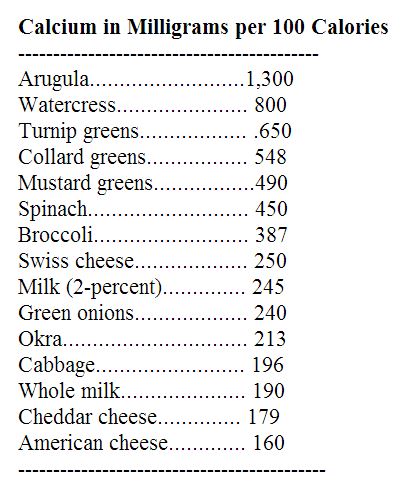
Now, let’s take a new look at milk and dairy products as a calcium source, regardless of their protein content. Calcium expressed as mg. per 100 calories instead of per gram show milk and cheese at the bottom of the list and green vegetables at the top (see chart).
At first glance, one may conclude, “but I would have to eat so much more spinach or kale to get adequate calcium.” Not so, individuals on a plant-based diet generally eat as many total calories as meat and dairy-eaters. In other words, adequate amounts of vegetables are BETTER SOURCES OF CALCIUM THAN MILK AND CHEESE. Also, consider that a cup of broccoli contains about the same amount of calcium as a cup of milk. But wait! Haven’t we been told that many green vegetables contain oxalic acid, which reduces the absorption of their calcium. This too, has been exaggerated by the dairy lobby. A 1990 report in the American Journal of Clinical Nutrition concluded that greens such as broccoli and kale have high levels of calcium which is absorbed at least as well as that in milk. Excellent calcium balance on a non-dairy diet is easily attained because ALL vegetables and legumes contain calcium, and collectively it’s more than adequate. This calcium stays in the bones, unlike much of that from the high protein-containing dairy products.
Now it begins to make sense. In cultures where the most protein is consumed, the calcium requirement for good bone density and protection against osteoporosis may be UNATTAINABLY high, without supplements — it’s a Catch-22. But for the majority of the world population, and among those consuming a plant-based diet in Western countries, calcium requirements for normal bone density are easily obtained without milk or other dairy products. Milk, it now seems clear, is not the solution to the malady of poor bone density. It may be a part of the problem, and you can have your calcium without the cow.
Want to avoid dementia?
Eat Less Meat, Dairy To Protect Brain

We’ve said it all along, and the research supports it. Want to avoid dementia? Then avoid meat and dairy. It’s so mainstream, it’s on the front of CNN.com.
Here’s an excerpt:
Eating a diet rich in healthy fats and
limiting dairy and meat could do more than keep
your heart healthier. It could also help keep you
thinking clearly.New research shows that sticking to the
Mediterranean diet, previously shown to reduce
heart and other health issues, also may help
lower the risk of having small areas of dead
tissue linked to thinking problems. Known as
brain infarcts, they’re involved in vascular
dementia, the second most common form of
dementia, after Alzheimer’s disease.“We’ve got these diseases of aging that cause
disability, cost a ton of money to treat and
manage, and wreck people’s lives,” said Dr.
Gregory Cole, a professor of medicine and
neurology at the University of California, Los
Angeles, who was not involved in this new study.
“You’ve got to get in there and figure out what
actually works for prevention, and not have
people guessing.”A Mediterranean diet includes a lot of fruit,
vegetables and fish, olive oil, legumes and
cereals, and fewer dishes containing dairy, meat,
poultry, and saturated fatty acids than other
diets. It also involves small to moderate amounts
of alcohol.
A Mediterranean Diet has less of what’s bad for you in it. It’s definitely better than the Standard American Diet, but not nearly as good as a healthy plant-based diet.
The closer you eat to a 100% plant-based diet, the healthier you can be.
High-risk medication-chemotherapy
‘It’s such a high-risk medication’: Researchers uncover potential errors in chemotherapy use at Canadian hospitals


Getty Images The study just published in the Journal of Oncology Pharmacy Practice stemmed from unique research that involved Human Era scientists actually “embedding” themselves in the pharmacies at six hospitals across Canada and observing how work was done.
Canadian researchers say they have uncovered several potential errors that could dangerously undermine the production of chemotherapy solutions — and threaten “catastrophic” consequences for some of the thousands of cancer patients treated with the drugs daily.
The just-published findings by scientists who “embedded” themselves in hospital pharmacies are already triggering changes in the facilities, and are part of a broader investigation into chemo safety prompted by the overdose death of an Edmonton cancer patient.
The wider probe uncovered mistakes such as hooking up patients to the wrong infusion pump, delivering the drugs perilously quickly and failing to infuse the crucial chemical cocktail at all.
A report on those findings was produced two years ago, but has never been reported on publicly before.
The toxic nature of chemotherapy makes it particularly critical to avoid errors in its use, said Rachel White, the latest study’s lead author and a “human-factors” expert at Toronto’s University Health Network (UHN).
Dosing of chemotherapy and the timing is a really complicated balance
“It’s such a high-risk medication,” said Ms. White, a researcher with HumanEra, a UHN project that aims to find systemic problems behind medical blunders, estimated to cause thousands of deaths a year in Canada.
“You bombard the system with these drugs, trying to get as many bad cells as you can, but accepting that you’re also going to take out some of the good cells as well. So dosing of chemotherapy and the timing is a really complicated balance.”
Given how dangerous chemotherapy can be, the work of preparing treatments is often stressful, especially when numerous patients are awaiting their infusions, said Kathy Gesy, Saskatchewan’s provincial leader of oncology pharmacy services. The system has taken to heart, however, the findings and advice highlighted in the new study and other research, she said.
“In the last four or five years, there have been major changes in how we work, all focused on safety,” said Ms. Gesy.
The overhaul quietly taking place in Canadian oncology wards stems largely from that Edmonton death in 2006 and the “courageous” decision by Dr. Tony Fields, head of the city’s Cross Cancer Institute, to make the tragic mishap public, said Ms. White. Dr. Fields was one of the authors on the latest study, along with the UHN’s Dr. Anthony Easty.
The Cross centre’s 43-year-old patient died when her infusion pump was wrongly programmed and a potent dose of the drug fluorouracil surged into her body over four hours, instead of the intended four days. A subsequent report by the Institute for Safe Medication Practices uncovered evidence of at least seven other accidental, fluorouracil-related deaths in recent years, though it was unclear if any occurred in Canada.
Ms. White and other members of HumanEra were asked to review the whole process of administering chemotherapy.
Their report in 2011 included results of a survey of 331 doctors, nurses and pharmacists involved in cancer care, who reported over 230 adverse events involving chemotherapy, though it is possible different people cited some of the same incidents.
The problems included attaching the wrong infusion pump to a patient, incorrectly calculating the volume of drugs, and “numerous cases” of the pump being clamped shut so the patient absorbed none of the medication. There were also 67 reports of events reminiscent of the Edmonton accident, the pump malfunctioning so it delivered too much or too little medicine. One professional reported “at least two incidents where … infusers emptied much faster/sooner than they were supposed to and patients were very ill as a result.”
That report and others have already brought about significant change, said Ms. White, like extensive new training on operating the pumps, and use of pre-printed forms that make ordering the drugs clearer.
The study just published in the Journal of Oncology Pharmacy Practice stemmed from unique research that involved HumanEra scientists actually “embedding” themselves in the pharmacies at six hospitals across Canada and observing how work was done.
The team highlighted three serious flaws: The lack of a second worker in some pharmacies to check whether a chemotherapy solution had been properly combined; work surfaces where several bags of chemicals were being prepared at one time, raising the risk of mix-ups; and failing to keep a label bearing the patient’s name attached to the infusion bag at all times, increasing the chances of giving patients the wrong drugs. The study includes a photograph of a pharmacy technician with a jumble of prescriptions pinned to a board above his bench, with the corresponding bags below, not unlike a busy restaurant cook surveying dinner orders.
Once the bag leaves the pharmacy, though, no one would know a mistake had been made, the researchers note. They are launching a new study to analyze the contents of completed chemotherapy bags to determine how often they contain the wrong ingredients.
National Post
Vitamin D And Prostate Cancer
From the Vitamin D Council Newsletter by Dr John Cannell
Prostate cancer tends to develop in men over the age of fifty and, although it is one of the most prevalent types of cancer in men, many men never have symptoms and die of other causes. On the other hand, more aggressive prostate cancers account for more cancer-related deaths than any cancer except lung cancer. About two-thirds of cases are slow growing, the other third are more aggressive and fast growing.
The decision to treat a tumor contained within the prostate is a trade-off between the risk and expected benefits, especially quality of life. More and more often physicians and patients are electing to do nothing but wait (and hopefully enjoy life) for slow growing tumors.
The decision to wait is a calculated risk. Urologists look at a number of factors in prostate cancer to decide how to treat (if at all) prostate cancer. These factors include:
- Gleason Score: score given to prostate cancer based upon its microscopic appearance. Cancers with a higher Gleason score are more aggressive and have a worse prognosis. The Gleason scores range from 2 to 10, with 10 having the worst prognosis.
- Core biopsies positive: usually urologists take 6-12 total biopsies at a time, called cores. The percentage of positive cores varies and often changes over time.
- PSA: a tumor marker that, taken with the other two factors above, may indicate prostate cancer. The higher the score, and the more rapidly it climbs, the worse the prognosis. It usually slowly increases over time in men with low-grade prostate cancer.
All of these factors, along with the presence or absence of cancer spread, change over time and influence whether or not an urologist and patient decide to treat the prostate cancer.
To give you an idea about how this works, if you took 20 men with low risk prostate cancer and do nothing but biopsy them again in a year, about 10% of the men will no longer have any cores positive. That’s right, about 10% of men will no longer have demonstrable cancer. However, most men will have either more cores positive or a higher Gleason score or higher PSA or all three.
This week, Drs. David Marshall, Sebastiano Gattoni-Celli and their colleagues from the Medical University at South Carolina published a study that reported administering vitamin D for a year, measuring cancer markers before and after. The results were astounding.
This study administered 4,000 IU/day of vitamin D for one year to 44 men. The scientists chose 44 men with low risk prostate cancer, so they chose 44 men with identical Gleason scores of 6, anywhere from 1-6 cores positive (out of 12 possible), and a PSA < 10.
Of the 44 men they followed, 60% showed a decrease in the number of positive cores or a decrease in their Gleason scores, or both. Only 34% showed an increase in the number of positive cores or an increase in their Gleason scores. 6% were unchanged over the year. PSA levels did not go up over the year. The authors classified 60% of the men as “responders” to vitamin D and 40% as “non-responders.”
Fifteen of the 44 men (34%) no longer had any cores positive. However, PSA did not go down so they may or may not still have prostate cancer. It also appeared that baseline vitamin D levels were important because men with higher baseline vitamin D levels had fewer cores positive for cancer and lower Gleason scores.
The authors report that the main problem with the study was the lack of a control group, other than historical groups of men treated conservatively. However, with 60% of the men responding to vitamin D, I wonder if an ethics committee would allow a randomized controlled trial, knowing some men in the control group would be vitamin D deficient.
Doctors Say Dairy Industry Should Warn Consumers That Milk Can Make Them Sick
Ten D.C.-area residents seeking lactose intolerance warnings on milk cartons will ask the U.S. Court of Appeals for the District of Columbia Circuit to overturn an unfavorable ruling by the U.S. District Court. The lawsuit was filed October 6, 2005, by the Physicians Committee for Responsible Medicine (PCRM) because many people are unaware that milk may cause severe gastrointestinal symptoms. The defendants, including Giant Food and Safeway, do not deny that lactose intolerance is a painful consequence of drinking milk, but have argued that warning consumers would cause a decline in sales.
“The dairy industry has an obligation to warn consumers that milk can make them painfully sick,” says Dan Kinburn, Esq., associate general counsel for PCRM. “We believe the appeals court will overturn this anti-consumer ruling to protect the health of thousands of District residents who are lactose intolerant or allergic to milk.”
The plaintiffs argue that many people are not aware they are lactose intolerant and unwittingly buy milk, only to suffer side effects after drinking it. Lactose intolerance is the biological norm and mainly affects people of color. But because the condition comes on gradually and can start at any age, many individuals have no idea that milk is the culprit in their painful symptoms.
Lactose intolerance is caused by the loss of the enzymes that digest the milk sugar lactose, a normal process that occurs after the age of weaning. For those who are lactose intolerant, drinking milk can result in abdominal pain, diarrhea, and other painful gastrointestinal symptoms. Approximately 75 percent of the world’s population “including 60 to 80 percent of African-Americans, 50 to 80 percent of Latinos, and at least 90 percent of Asian-Americans and Native Americans” is lactose intolerant.
The lawsuit was filed by Milton Mills, M.D., an African-American physician, and nine others who are suing on behalf of all D.C. residents who are lactose intolerant and not aware of it.
Founded in 1985, the Physicians Committee for Responsible Medicine is a nonprofit health organization that promotes preventive medicine, especially good nutrition. PCRM also conducts clinical research studies, opposes unethical human experimentation, and promotes alternatives to animal research.
Alkaline Foods
Discover How The Alkaline Diet Works & Why Alkaline Foods Are Highly Recommended
Too Much Acid in Your Body Can Cause a Host of Health Problems…
Most people don’t feel any where near as good as they could.
In fact, the vast majority of people feel that their lack of energy and health is just part of the aging process.
The funny thing is, so many people I know have nagging health problems. They’re baffled why they no longer feel as good as they did when they were a child.
In fact, they haven’t got a clue. And that really makes sense when you consider the types of foods they’re eating day-to-day, and the dangerous, often toxic, medications they’ve used throughout life.
But let me ask you something: Do you think medication is the answer to health problems?
Of course not. If medication or a magic pill was the real answer, then you’d already feel as good as you want to be.
For many years mainstream medicine ignored the role that diet can play in both health and disease. More recently it began emphasizing the need to eat healthier foods to keep illness at bay.
One of the most exciting discoveries has been the effect some foods have on the body’s acid-alkaline pH levels when digested.
A Slightly Alkaline Body Is Crucial For Good Health
Regardless of how much you work out and try to eat right, if you can’t balance the acids in your body, you’ll never feel as good as you’d like to be.
The problem is, on a whole, the average western diet is acid-producing. And when acidic wastes accumulate, they can cause organs to malfunction and break down.
We are forcing our bodies to work with less than optimal inner terrain.
This creates a fertile breeding ground for various forms of chronic illness that are now experienced by more than half the population.
If you often feel tired, it’s a safe bet that you are overly acidic. The simple fact is, most people are. You need to counter acidity with alkaline foods as soon as possible.
Eating the proper foods and getting the best nutrients in balance will help you avoid all that – along with the misery and poor quality of life that so often precede death, sometimes by decades.
Inside you’ll learn the rules of alkaline dieting:
- Say good-bye to low energy, poor digestion, extra pounds, aches and pains, and disease.
- Say hello to renewed vigor, mental clarity, better over-all health, and a lean trim body. The key? Your health depends on the pH balance of the blood.
- Which foods explode your energy levels and make you feel incredible as soon as you wake up.
- Muscle up your energy levels – 12 perfect foods.
- Restore your health by creating a balance in your diet that will give you the energy of a child again.
- More Energy! Where to find it for energy all afternoon.
- Boost your alkalinity and lose weight fast – 10 easy tricks.
- Use no diet until you have tried alkaline foods. I guarantee you results in just 1 week. Get healthy, not old.
Enter your name and email in the form provided to discover how a high alkaline diet works and why alkaline foods are highly recommended.
 The Way To Eat