South Indian-Style Vegetable Curry

South Indian-Style Vegetable Curry
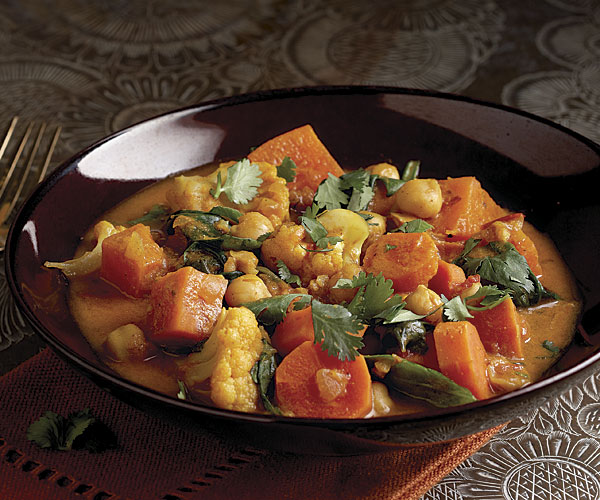
051107033-01-indian-vegetable-curry-recipe_xlg

by Ellie Krieger
from Fine Cooking
Issue 107

This easy one-pot meatless main gets its complex flavor from a combination of spices including coriander, cumin, turmeric, cayenne, and cinnamon. The spices marry in a rich, flavorful sauce that has a comforting, belly-warming appeal.

Read Ellie Krieger’s blog post to learn more about the healing power of spices and how this recipe came together.

more about:

garlic coriander seeds ginger onions canola oil cumin seeds turmeric cayenne tomato paste vegetable stock coconut milk cinnamon sea salt black peppercorns cauliflower sweet potatoes tomatoes carrots chickpeas spinach limes cilantro
2 Tbs. canola oil
1 large yellow onion, finely diced
4 medium cloves garlic, minced
One 2-inch piece fresh ginger, peeled and finely grated (1 Tbs.)
1 Tbs. ground coriander
1-1/2 tsp. ground cumin
3/4 tsp. ground turmeric
1/2 tsp. cayenne
1 Tbs. tomato paste
2 cups lower-salt chicken broth or vegetable broth
1 cup light coconut milk
One 3-inch cinnamon stick
Fine sea salt and freshly ground black pepper
1 small cauliflower, broken into 1-1/2-inch florets (about 4 cups)
1 lb. sweet potatoes, peeled and cut into 1-inch cubes (about 3 cups)
2 medium tomatoes, cored, seeded, and coarsely chopped (about 1-1/2 cups)
2 large carrots, peeled and cut into 1/2-inch-thick rounds (about 1 cup)
One 15-1/2-oz. can chickpeas, drained and rinsed
4 oz. baby spinach (about 4 lightly packed cups)
2 Tbs. fresh lime juice
1 tsp. finely grated lime zest
2 Tbs. chopped fresh cilantro
In a 5- to 6-quart Dutch oven or other heavy-duty pot, heat the oil over medium-high heat. Add the onion and cook, stirring occasionally, until beginning to brown, 3 to 4 minutes. Reduce the heat to medium (or medium low if necessary) and cook until the onion is richly browned, 5 to 7 minutes more. Add the garlic and ginger; cook, stirring, for 1 minute to blend the flavors. Add the coriander, cumin, turmeric, and cayenne; stir for 30 seconds to toast the spices. Add the tomato paste and stir until well blended with the aromatics, about 1 minute.

Add the broth, coconut milk, cinnamon stick, 1 tsp. salt, and 1/4 tsp. pepper and bring to a boil. Reduce the heat to medium low or low and simmer for 10 minutes.

Add the cauliflower, sweet potatoes, tomatoes, and carrots. Raise the heat to medium high and return to a boil. Reduce the heat to medium low, cover, and simmer until the vegetables are tender, 20 to 25 minutes. Discard the cinnamon stick.

Stir in the chickpeas, spinach, lime juice, and zest; cook until the spinach has wilted, about 3 minutes more. Season to taste with salt. Serve garnished with the cilantro.

Serving Suggestions
This curry only needs a basic brown rice or white basmati rice to be a complete meal.

nutrition information (per serving):
Calories (kcal): 300; Fat (g): 10; Fat Calories (kcal): 90; Saturated Fat (g): 2; Protein (g): 12; Monounsaturated Fat (g): 3.5; Carbohydrates (g): 45; Polyunsaturated Fat (g): 2.5; Sodium (mg): 680; Cholesterol (mg): 0; Fiber (g): 12;

PHOTO: SCOTT PHILLIPS

What’s Wrong with Eggs?

By    |   Posted on September 3, 2013 


Whats wrong with eggs 570x299 What’s Wrong with Eggs?A common question I hear as a dietitian (second only to “Where do you get your protein?” of course) is “What’s wrong with eggs?”

Where to begin? Let’s start with the obvious egg facts. Eggs have zero dietary fiber, and about 70 percent of their calories are from fat—a big portion of which is saturated. They are also loaded with cholesterol—about 213 milligrams for an average-sized egg. For reference, people with diabetes, cardiovascular disease, or high cholesterol should consume fewer than 200 milligrams of cholesterol each day. (Uh oh.) And, humans have no biological need to consume any cholesterol at all; we make more than enough in our own bodies.


Why so much fat and cholesterol in such a tiny package? Think about it: eggs hold every piece of the puzzle needed to produce a new life. Within that shell lies the capacity to make feathers, eyes, a beak, a brain, a heart, and so on. It takes a lot of stuff to make such a complex being.

In addition to these excessive (for humans) natural components of an egg, other human-health hazards exist. Because eggshells are fragile and porous, and conditions on egg farms are crowded, eggs are the perfect host for salmonella—the leading cause of food poisoning in the U.S.

Those are some facts and figures. But how do eggs affect real people in real life? Luckily, researchers have conducted good studies to help answer that question.

Cancer

In a 1992 analysis of dietary habits, people who consumed just 1.5 eggs per week had nearly five times the risk for colon cancer, compared with those who consumed hardly any (fewer than 11 per year), according to the International Journal of Cancer. The World Health Organization analyzed data from 34 countries in 2003 and found that eating eggs is associated with death from colon and rectal cancers. And a 2011 study funded by the National Institutes of Healthshowed that eating eggs is linked to developing prostate cancer. By consuming 2.5 eggs per week, men increased their risk for a deadly form of prostate cancer by 81 percent, compared with men who consumed less than half an egg per week. Finally, even moderate egg consumption tripled the risk of developing bladder cancer, according to a 2005 study published in International Urology and Nephrology.

Diabetes

A review of fourteen studies published earlier this year in the journalAtherosclerosis showed that people who consumed the most eggs increased their risk for diabetes by 68 percent, compared with those who ate the fewest.

In a 2008 publication for the Physicians’ Health Study I, which included more than 21,000 participants, researchers found that those who consumed seven or more eggs per week had an almost 25 percent increased risk of death compared to those with the lowest egg consumption. The risk of death for participants with diabetes who ate seven or more eggs per week was twice as high as for those who consumed the least amount of eggs.

Egg consumption also increases the risk of gestational diabetes, according to two 2011 studies referenced in the American Journal of Epidemiology. Women who consumed the most eggs had a 77 percent increased risk of diabetes in one study and a 165 percent increased risk in the other, compared with those who consumed the least.

Heart Disease

Researchers published a blanket warning in the Canadian Journal of Cardiology, informing readers that ceasing egg consumption after a heart attack would be “a necessary act, but late.” In the previously mentioned 14-study review, researchers found that people who consumed the most eggs increased their risk for cardiovascular disease by 19 percent, and if those people already had diabetes, the risk for developing heart disease jumped to 83 percent with increased egg consumption.

New research published this year has shown that a byproduct of choline, a component that is particularly high in eggs, increases one’s risk for a heart attack, stroke, and death.

Animal Protein

Inevitably, this discussion also leads to another question: “Even egg whites?” Yes, even egg whites are trouble. The reason most people purport to eat egg whites is also the reason they should be wary — egg whites are a very concentrated source of animal protein (remember, the raw material for all those yet-to-be-developed body parts?). Because most Westerners get far more protein than they need, adding a concentrated source of it to the diet can increase the risk for kidney disease, kidney stones, and some types of cancer.

By avoiding eggs and consuming more plant-based foods, you will not only decrease your intake of cholesterol, saturated fat, and animal protein, but also increase your intake of protective fiber, antioxidants, and phytochemicals. Be smart! Skip the eggs and enjoy better health!

Susan Levin, M.S., R.D.

Susan Levin, M.S., R.D.

Susan Levin, M.S., R.D., is director of nutrition education at the Physicians Committee for Responsible Medicine (PCRM), a Washington, D.C.-based nonprofit organization dedicated to promoting preventive medicine. Ms. Levin researches and writes about the connection between plant-based diets and a reduced risk of chronic diseases, including cancer, diabetes, and heart disease.

Curried Tomato Lentil Soup

By    |   Posted on September 5, 2013

Tomato Lentil Soup 570x299 Curried Tomato Lentil Soup (Shorba Addis)This recipe is based on an Ethiopian soup with a rich, deep curry flavor and complex textures. It’s easy to make in a big batch for the week ahead, but it’s so good, don’t expect it to last more than a couple of days.

Curried Tomato Lentil Soup (Shorba Addis)
From 21-Day Weight Loss Kickstart
Serves 3 

Ingredients:

• ½ yellow onion, diced
• 1 small carrot, diced
• 1 teaspoon freshly grated ginger
• 3 cloves garlic, minced
• 1 tablespoon curry powder (berbere is preferable)
• 1 teaspoon fenugreek seeds
• 2½ cups vegetable broth
• ¼ cup tomato paste
• ¼ cup brown or green lentils
• 1 Yukon Gold potato, diced
• ¼ cup whole-wheat orzo pasta

Instructions

Over medium-high heat, sauté the onion until it is brown. Reduce the heat to medium. Add the carrot, ginger, garlic, curry powder, and fenugreek, sautéing them for about 1 minute. Add the veggie broth and tomato paste, stirring until the tomato paste is thoroughly combined with the broth. Bring the soup to a simmer. Add the lentils and stir. Once the soup comes back to a simmer, cover the pot and reduce the heat to low. Cook the soup for 20 minutes. Add the potato and orzo; cook the soup, covered, for 5 more minutes.

Chef’s Notes:

Making It Simple: Bring the veggie broth and tomato paste to a simmer, making sure the tomato paste is thoroughly combined with the broth.

Add the onion, carrot, garlic, ginger, curry, fenugreek, and lentils and proceed with the above recipe as if you had just added the lentils.

The Gourmet Touch: This is an Ethiopian soup, so its flavor is best created using berbere—an Ethiopian curry mix.

Core Concepts: The key to this soup is timing when you add the ingredients. Lentils require time to cook, while diced potatoes and orzo pasta need only a few minutes; these are best added to a soup during the last few minutes of cooking.

Ginger: Truly Among the Great Medicines of the World

by 
August 29th, 2013

ginger root sliced 263x164 Ginger: Truly Among the Great Medicines of the WorldFor centuries, people around the world have used used ginger for medicinal purposes. So did Confucius. He said he never ate a meal without it. Henry VIII recommended ginger to keep the plague away. English taverns in the nineteenth century used ginger in their beer. The Romans and Greeks used the herb in place of dramamine for long voyages at sea. Indians used it in Ayuverdic concotions. This incredible ‘hand’, or root of the Zingiber officinale, is an incredible food with numerous and wonderful healing qualities that have been experienced for at least the last 4400 years, if not longer.

Ginger originates from Southeast Asia, but grows well in multiple climates. It now grows all over Europe, the US, China, Japan, Vietnam, Indonesia, and elsewhere.

Full of antioxidants, iron, phosphorous, potassium, riboflavin, and more, ginger can kill salmonella as well as other undesirable viruses (including the common cold), and clots blood better than onion or garlic while reducing blood coagulation by inhibiting the cell synthesis of thromboxane. The spice can lower ‘bad’ cholesterol, can be used as a drug-free pain killer, helps with stomach ailments, and reduces nausea. It improves digestion by increasing salivary and stomach secretions.

Japanese biochemists have also proven that ginger is one of many cancer-fighting foods, reducing cell mutation which can lead to cancer. Another study coming to similar conclusions showed that ginger extract triggered apoptosis of G cells HCT 116 and HT 29 – cancer causing cellular lines.

Check out this article for a more in-depth and complete list of the health benefits of ginger.

Ginger can be used in cooking, taken as a supplement, or even consumed in teas or ginger candies. In India, children are given ginger to guard against whopping cough. Just a ¼ teaspoon of ginger per serving of cooked foods can deliver a great zing to vegetables or broths for soup and deliver all the powerful medicine that ginger offers to cure multiple ailments. You can grate the root into a pulp and use it fresh or find an organic extract to use in a pinch. Ginger never fails to deliver great taste and overall immune support and physical well-being.

Read more: http://naturalsociety.com/ginger-great-medicine-of-world/#ixzz2dXXgDZHN
Follow us: @naturalsociety on Twitter | NaturalSociety on Facebook

The Best Foods: test your nutrition knowledge

The Best Foods: test your nutrition knowledge

November 6, 2011 by Michael Greger M.D. in News with 11 Comments


Today I’m highlighting twenty questions from twenty NutritionFacts.org “best of” videos ranking different classes of foods. Ultimately, the “best” apple, bean, vegetable, etc. is whichever one you actually eat (in the same way that the “best” exercise is the exercise you actually do), but if you’re in a position to choose, then why not shoot for the best of the best?

The first 20 people to email me all 20 correct answers will win my latest nutrition DVD. Watch the videos for the answers and email me atnutritioncontest@gmail.com—and good luck!

1. The best apple:
a. Braeburn
b. Cortland
c. Empire
d. Fuji
e. Gala
f. Golden delicious
g. Golden nugget
h. Granny Smith
i. Honeycrisp
j. Idared
k. Red delicious

2. The best bean:
a. Black
b. Chickpea
c. Green split pea
d. Kidney
e. Lentil
f. Pinto
g. Yellow split pea

3. Best anticancer vegetable:
a. Acorn squash
b. Asparagus
c. Beets
d. Bok choi
e. Boston lettuce
f. Broccoli
g. Brussels sprouts
h. Carrot
i. Cauliflower
j. Celery
k. Cucumber
l. Curly cabbage
m. Eggplant
n. Endive
o. Fennel
p. Fiddlehead ferns
q. Garlic
r. Green bean
s. Green cabbage
t. Green onion
u. Jalapeno
v. Kale
w. Leek
x. Orange bell pepper
y. Potato
z. Radicchio
aa. Radish
bb. Red cabbage
cc. Romaine lettuce
dd. Rutabaga
ee. Spinach
ff. Tomato
gg. Yellow onion

4. The best cooking method:
a. Baking
b. Boiling
c. Frying
d. Griddling
e. Microwaving
f. Pressure cooking

5. The best mushroom (based on antioxidant content):
a. Button
b. Chanterelles
c. Morels
d. Oyster
e. Porcini
f. Shiitake

6. The best mushroom for breast cancer prevention:
a. Button
b. Chanterelle
c. Crimini
d. Enoki
e. Italian brown
f. Oyster
g. Portobello
h. Shiitake
i. Stuffing
j. Woodear

7. The best rice:
a. Black rice
b. Brown rice
c. Red rice
d. White rice

8. The best nut:
a. Almond
b. Brazil nut
c. Cashew
d. Macadamia
e. Pecan
f. Peanut
g. Pine Nut
h. Pistachio
i. Walnut

9. The best airplane beverage:
a. Apple juice from concentrate
b. Cranberry juice cocktail
c. Hot coffee
d. Hot tea
e. Orange juice from concentrate
f. Tomato juice from concentrate
g. Water

10. The best onion:
a. Red
b. White
c. Yellow

11. The best lentil:
a. Red
b. Green
c. French green

12. The healthiest sweetener:
a. Agave nectar
b. Blackstrap molasses
c. Brown rice syrup
d. Corn syrup
e. Dark brown sugar
f. Date sugar
g. Honey
h. Light brown sugar
i. Maple syrup
j. Raw cane sugar
k. Sugar
l. Turbinado sugar

13. The best low-calorie sweetener:
a. Acesulfame-K
b. Aspartame
c. Cyclamate
d. Erythritol
e. Saccharin
f. Stevia
g. Sucralose
h. Xylitol

14. Healthiest chocolate fix:
a. Baking chocolate
b. Chocolate syrup
c. Cocoa powder
d. Dark chocolate
e. Milk chocolate
f. Semi-sweet chocolate

15. The best tea:
a. Black
b. Green
c. White
d. Depends on whether you add lemon

16. Which is the healthiest soy food?
a. Edamame
b. Soy milk
c. Tempeh
d. Tofu

17. The best microscopic green:
a. Blue-green algae
b. Chlorella
c. Spirulina
d. None of the above

18. The better seed:
a. Chia
b. Flax

19. Most antioxidants per serving:
a. A half cup of acai berries
b. A half cup of blueberries
c. A half cup of cranberries
d. A half cup of goji berries
e. A handful of pecans
f. A pomegranate
g. A tablespoon of cocoa powder
h. A teaspoon of cinnamon
i. An apple
j. An artichoke
k. One black plum
l. One pear

20. Best antioxidant bargain:
a. Acai
b. Apples
c. Artichokes
d. Cinnamon
e. Cloves
f. Cranberries
g. Goji Berries
h. Pecans
i. Purple Cabbage

Email me your answers at nutritioncontest@gmail.com along with your mailing address to win!

-Michael Greger, M.D.

Is salt healthy?

Salt-composed of sodium and chloride-is a mineral that is ubiquitous in the food supply. Unfortunately, this means that it is too easy to take in large quantities without even realizing it. We only need 1,500 mg per day, and yet, the average American consumes 3,466 mg daily. High amounts can lead to or exacerbate high blood pressure, can increase the risk of gastric cancer, and are taxing on the kidneys. Many people are also salt-sensitive. A mere teaspoon of salt contains 2,300 mg of sodium, which is already more than our daily requirement. To prevent over consumption, limit processed foods, cheese, many restaurant dishes, and cook with as little salt as possible. Further, add the salt you cook with towards the end of cooking so the flavor will be noticeable. Remember that your palate quickly adjusts to how much salt you consume…the more you have, the more you need. It is easy to slowly wean off salt, and eventually, you will notice you don’t prefer salty foods.

By Julieanna Hever, R.D.

Mac & Casheese

Mac & Casheese
by Katie Mae, MS

I think it’s safe to say everyone loves a warm, creamy Mac and Cheese. I know I do, if it’s vegan of course. This American favorite is traditionally made with butter, milk and cheese, which is unnecessarily rich. This tasty alternative is made creamy and cheesy with cashews and nutritional yeast. Plus I threw in some nutrient-dense veggies to add even more color, texture and flavor. Enjoy!

Ingredients
16 ounces macaroni (preferably brown rice or quinoa-based noodles)
2 cups broccoli, chopped
1½ cups peas
1 cup water
¾ cup nutritional yeast
½ cup cashew powder (just ground-up cashews)
1½ tablespoons tahini, salt-free preferred
½ lemon, juiced
1 teaspoon turmeric
½ teaspoon garlic granules
1-2 teaspoon mellow white miso (optional)
Freshly ground pepper to taste

Directions
Cook pasta according to package directions; drain and set pasta aside in original saucepan. In a separate medium saucepan, steam broccoli by placing 1 to 2 inches of water on bottom, a steam basket on top, and broccoli in the basket. Cover with lid slightly ajar and cook over medium heat for several minutes, or until desired softness is reached. Place peas in a small bowl and set aside.

Place all remaining ingredients in a blender and blend until sauce has a creamy consistency. Place pasta saucepan (containing pasta) over low heat. Fold sauce into pasta. Add broccoli and peas and stir well. Let cook for just a few minutes to allow flavors to marry. Sprinkle with black pepper and serve hot.

Makes 4-6 servings

Fructose, Sweet but Dangerous

Is High Fructose Corn Syrup Worse Than Sugar?

By , About.com Guide

Updated October 09, 2008

About.com Health’s Disease and Condition content is reviewed by our Medical Review Board

high fructose corn syrupSodas are Usually Sweetened with High Fructose Corn SyrupPhoto: Scott Olson/Getty Images

What is fructose?

Fructose is a monosaccharide (simple sugar), which the body can use for energy. Because it does not cause blood sugar rise tremendously (has a low glycemic index), it was once thought that fructose was a good substitute for sucrose (table sugar). However, the American Diabetes Association and nutritional experts have changed their minds about this.

Is fructose bad for me?

A small amount of fructose, such as the amount found in most vegetables and fruits, is not a bad thing. In fact, there is evidence that a little bit may help your body process glucose properly. However, consuming too much fructose at once seems to overwhelm the body’s capacity to process it. The diets of our ancestors contained only very small amounts of fructose. These days, estimates are that about 10% of the modern diet comes from fructose.

What happens if I consume too much fructose?

Most of the carbohydrates we eat are made up of chains of glucose. When glucose enters the bloodstream, the body releases insulin to help regulate it. Fructose, on the other hand, is processed in the liver. To greatly simplify the situation: When too much fructose enters the liver, the liver can’t process it all fast enough for the body to use as sugar. Instead, it starts making fats from the fructose and sending them off into the bloodstream as triglycerides.

Why is this bad?

This is potentially bad for at least three reasons:

  • High blood triglycerides are a risk factor for heart disease.
  • Fructose ends up circumventing the normal appetite signaling system, so appetite-regulating hormones aren’t triggered–and you’re left feeling unsatisfied. This is probably at least part of the reason why excess fructose consumption is associated with weight gain.
  • There is growing evidence that excess fructose consumption may facilitate insulin resistance, and eventually type 2 diabetes. However, some of this effect may be from chemicals in soda which reacts with the high fructose corn syrup.

What are the major sources of fructose?

Fruits and vegetables have relatively small, “normal” amounts of fructose that most bodies can handle quite well. The problem comes with added sugars in the modern diet, the volume of which has grown rapidly in recent decades. The blame has often been pinned to high fructose corn syrup (HFCS), which is made up of 55% fructose and 45% glucose. However, sucrose is half fructose and half glucose. So, HFCS actually doesn’t have a whole lot more fructose than “regular” sugar, gram for gram.High fructose corn syrup has become incredibly inexpensive and abundant, partially due to corn subsidies in the United States. So, really, the problem is more that it has become so cheap that it has crept its way into a great number of the foods we eat every day.

Is corn syrup fructose different than fructose found in other foods?

No, all fructose works the same in the body, whether it comes from corn syrup, cane sugar, beet sugar, strawberries, onions, or tomatoes. Only the amounts are different. For example, a cup of chopped tomatoes has 2.5 grams of fructose, a can of regular (non-diet) soda supplies 23 grams, and a super-size soda has about 62 grams.

Which foods have high fructose corn syrup and other sugars?

Today, almost all packaged foods have sugar added in some form, which almost always includes a lot of fructose. Honey has about the same fructose/glucose ratio as high fructose corn syrup. Fruit juice concentrates, sometimes used as “healthy sweeteners,” usually have quite a lot of fructose (never mind that the processing of these concentrates strips away most of their nutritional value). Look at the ingredients on packaged food labels and you will probably see sources of fructose. See my article, Sugar’s Many Disguises, to learn what to look for.

The Myth of Complementary Protein


By    |   Posted on June 3, 2013


The Myth of Complementary Protein 570x299 The Myth of Complementary Protein

Recently, I was teaching a nutrition class and describing the adequacy of plant-based diets to meet human nutritional needs. A woman raised her hand and stated, “I’ve read that because plant foods don’t contain all the essential amino acids that humans need, to be healthy we must either eat animal protein or combine certain plant foods with others in order to ensure that we get complete proteins.”


I was a little surprised to hear this, since this is one of the oldest myths related to vegetarianism and was disproved long ago. When I pointed this out, the woman identified herself as a medical resident and stated that her current textbook in human physiology states this and that in her classes, her professors have emphasized this point.

I was shocked. If myths like this abound not only in the general population but also in the medical community, how can anyone ever learn how to eat healthfully? It is important to correct this misinformation, because many people are afraid to follow healthful, plant-based, and/or total vegetarian (vegan) diets because they worry about “incomplete proteins” from plant sources.

How did this “incomplete protein” myth become so widespread?

No Small Misconception

The “incomplete protein” myth was inadvertently promoted and popularized in the 1971 book, Diet for a Small Planet, by Frances Moore Lappé. In it, the author stated that plant foods are deficient in some of the essential amino acids, so in order to be a healthy vegetarian, you needed to eat a combination of certain plant foods at the same time in order to get all of the essential amino acids in the right amounts. It was called the theory of “protein complementing.”

Lappé certainly meant no harm, and her mistake was somewhat understandable. She was not a nutritionist, physiologist, or medical doctor; she was a sociologist trying to end world hunger. She realized that converting vegetable protein into animal protein involved a lot of waste, and she calculated that if people ate just the plant protein, many more could be fed. In the tenth anniversary edition of her book (1981), she retracted her statement and basically said that in trying to end one myth—the inevitability of world hunger—she had created a second one, the myth of the need for “protein complementing.”

In this and later editions, she corrects her earlier mistake and clearly states that all plant foods typically consumed as sources of protein contain all the essential amino acids, and that humans are virtually certain of getting enough protein from plant sources if they consume sufficient calories.

Amino Acid Requirements

Where did the concept of essential amino acids come from and how was the minimum requirement for essential amino acids derived? In 1952, William Rose and his colleagues completed research to determine the human requirements for each of the eight essential amino acids. They set the minimum amino acid requirement equal to the greatest amount required by any single person in their study. Then to arrive at the recommended amino acid requirement, they simply doubled the minimum requirements. This recommended amount was considered a definite safe intake.

Today, if you calculate the amount of each essential amino acid provided by unprocessed plant foods and compare these values with those determined by Rose, you will find that any single whole natural plant food, or any combination of them, if eaten as one’s sole source of calories for a day, would provide all of the essential amino acids and not just the minimum requirements but far more than the recommended requirements.

Modern researchers know that it is virtually impossible to design a calorie-sufficient diet based on unprocessed whole natural plant foods that is deficient in any of the amino acids. (The only possible exception could be a diet based solely on fruit).

Pride and Prejudice

Unfortunately, the “incomplete protein” myth seems unwilling to die. In an October 2001 article on the hazards of high-protein diets in the medical journalCirculation, the Nutrition Committee of the American Heart Association wrote, “Although plant proteins form a large part of the human diet, most are deficient in one or more essential amino acids and are therefore regarded as incomplete proteins.”1 Oops!

Medical doctor and author John McDougall wrote to the editor pointing out the mistake. But in a stunning example of avoiding science for convenience, instead of acknowledging their error, Barbara Howard, Ph.D., head of the Nutrition Committee, replied on June 25, 2002 to Dr. McDougall’s letter, stating (without a single scientific reference) that the committee was correct and that “most [plant foods] are deficient in one or more essential amino acids.” Clearly, the committee did not want to be confused by the facts.

Maybe you are not surprised by this misconception in the medical community, but what about the vegetarian community?

Behind the Times

Believe it or not, an article in the September 2002 issue of Vegetarian Timesmade the same mistake. In a story titled “Amazing Aminos,” author Susan Belsinger incorrectly stated, “Incomplete proteins, which contain some but not all of the EAAs [essential amino acids], can be found in beans, legumes, grains, nuts and green leafy vegetables…. But because these foods do not contain all of the EAAs, vegetarians have to be smart about what they eat, consuming a combination of foods from the different food groups. This is called food combining.”

A Dangerous Myth

To wrongly suggest that people need to eat animal protein for proper nutrition encourages consumption of foods known to contribute to the incidence of heart disease, diabetes, obesity, many forms of cancer, and other common health problems.