Russell Henry Chittenden Tells the Truth a Century Ago

Russell Henry Chittenden Tells the Truth a Century Ago

Such narrow-minded thinking should have been stopped by 1905 when Russell Henry Chittenden, Yale UniversityProfessor of Physiological Chemistry, published his scientific findings on human protein needs in his classic book,Physiological Economy in Nutrition.2  Professor Chittenden believed Dr. Voit had cause and effect reversed: people did not become prosperous because they ate high protein diets, but rather they ate meat and other expensive high protein foods because they could afford them.   One hundred years ago he wrote, “We are all creatures of habit, and our palates are pleasantly excited by the rich animal foods with their high content of proteid (protein), and we may well question whether our dietetic habits are not based more upon the dictates of our palates than upon scientific reasoning or true physiological needs.”

He reasoned that we should know the minimal protein requirement for the healthy man (and woman), and believed that any protein intake beyond our requirements could cause injury to our body, especially to the liver and kidneys. As he explained it, “Fats and carbohydrates when oxidized in the body are ultimately burned to simple gaseous products…easily and quickly eliminated…”  “With proteid (protein) foods…when oxidized, (they) yield a row of crystalline nitrogenous products which ultimately pass out of the body through the kidneys.  (These nitrogen-based protein byproducts) – frequently spoken of as toxins – float about through the body and may exercise more or less of a deleterious influence upon the system, or, being temporarily deposited, may exert some specific or local influence that calls for their speedy removal.”  With these few words Professor Chittenden explained the deleterious effects of diets high in protein and meat – consequences too few practicing doctors know about today.

The First Scientific Experiments on Our Protein Needs

Professor Chittenden’s first experiment was on himself.  For nine months, he recorded his own body weight, which decreased from 143 pounds (65 Kg) to 128 pounds (58 kg) on his new diet of one-third the protein that Dr. Voit recommended. Chittenden’s health remained excellent and he described his condition as being with “greater freedom from fatigue and muscular soreness than in previous years of a fuller dietary.”  He had suffered from arthritis of his knee and discovered that by reducing his intake of meat his condition disappeared and his “sick headaches” and bilious attacks (abdominal pains) no longer appeared periodically as before; plus he fully maintained his mental and physical activity, with a protein intake of about 40 grams a day.

Chittenden performed valid scientific studies by collecting data on the daily dietary and urine histories of his subjects (including himself) to determine protein utilization. Because he was contradicting the known “truths” of his time, he proceeded with extreme caution with his further investigations.  He organized three controlled trials with increasing demands for testing the adequacy of diets lower in protein than commonly recommended.

The first trial involved a group of five men connected with Yale University, leading active lives but not engaged in very muscular work.  On a low-protein diet (62 grams daily) for 6 months, they all remained healthy and in positive nitrogen balance (more protein went into, than out of, their bodies).  The second trial used 13 male volunteers from the Hospital Corps of the U.S. army. They were described as doing moderate work with one day of vigorous activity at the gymnasium.  They remained in good health on 61 grams of protein daily.  His final trial was with 8 Yale student athletes, some of them with exceptional records of athletic events.  They ate an average of 64 grams of protein daily while maintaining their athletic endeavors, and improving their performance by a striking 35 percent.  Following these studies, Chittenden in 1904 concluded that 35–50 g of protein a day was adequate for adults, and individuals could maintain their health and fitness on this amount.  Studies over the past century have consistently confirmed Professor Chittenden’s findings, yet you would hardly know it with the present day popularity of high protein diets.
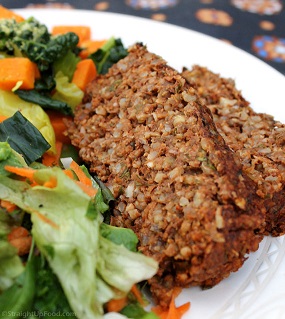
Lentil & Rice Loaf

december 19, 2013 by  41 comments

This flavorful loaf is perfect for the holidays, or anytime you want a hearty main dish. It can be made with fresh or dried herbs. Make two loaves while you’re at it and freeze one for leftovers. This is delicious topped with Creamy Mushroom Gravy!

LentilRiceLoaf Small

Ingredients
1¾ cups water
½ cup brown-green lentils
½ cup short-grain brown rice
2 teaspoons dried poultry seasoning
1 teaspoon granulated onion
1 medium onion, chopped
5 medium white or brown (cremini) mushrooms
1 large rib celery, chopped
1 tablespoon freshly minced garlic (about 5 medium cloves)
¾ cup quick-cooking rolled oats
1 can (6 ounces) tomato paste
½ cup chopped pecans or walnuts (optional)
1 tablespoon minced fresh sage leaf (or 1½ teaspoons dried, rubbed sage)
2 teaspoons minced fresh thyme (or 1 teaspoon dried)
1½ teaspoons minced fresh rosemary (or ¾ teaspoon dried)

Instructions
1. In a medium saucepan on high heat, combine water, lentils, rice, poultry seasoning, and granulated onion. Bring to a boil then turn down to simmer, and cook covered for 45 minutes. When done cooking, remove from the heat and let stand for 10 minutes with the lid still on. (Prepare your remaining ingredients while the rice and lentils are cooking.)

2. Preheat oven to 350 degrees. Line a standard size loaf pan (9 by 5 by 3-inch) with parchment paper (see photo below) and set aside (or use a silicone loaf pan).

3. In a medium skillet on high heat, add 1 tablespoon of water. When the water begins to sputter, add the chopped onion, mushrooms, and celery, and cook stirring for about 3 minutes, adding water just as needed to prevent sticking. Add the garlic, and cook stirring for an additional 2 minutes, until the vegetables have softened (adding water as needed). If you’re using dried herbs, stir them in with the garlic (if using fresh herbs, add them in next step). Remove from heat.

4. In a large bowl combine the oats, tomato paste, nuts, and if you’re using fresh herbs (rosemary, thyme, sage) add them now as well. When the cooked vegetables, and rice and lentils have cooled for about 10 minutes, add them to the bowl and stir until all ingredients are mixed thoroughly.

5. Place half of this mixture into a food processor. Pulse about 3 times, then scrape down sides; pulse another 3 times, so it gets blended but is still somewhat chunky. Spoon this into the loaf pan. Place the remaining mixture into the food processor and repeat pulsing in the same way. Add this second half to the loaf pan. Press down firmly and into the corners. Shape the top flat or with a slight rise down the middle.

6. Cover with a piece of aluminum foil and cook for 40 minutes. Remove the foil and cook for another 15 to 20 minutes until the top is browned and the edges are crispy looking. Remove and let cool 10 to 15 minutes before slicing and serving. Serve as is or with Mushroom Gravy or homemade ketchup.

Preparation: 55 minutes (including cooking rice and lentils)
Cooking: 55 minutes (baking loaf)
Makes: 1 standard loaf (about 10 ¾-inch slices)

NOTES

Herbs: During the holidays I like to use fresh herbs in this recipe, especially fresh sage, as its aroma and flavor are very “holiday.” But fresh herbs aren’t always practical, so feel free to use the measurements for dried. Or even a mix of fresh and dried.

Rolled oats: I like quick oats in this recipe, but if you only have “slow” oats, just pulse them a bit first in the food processor.

Blending: I’ve also made this loaf without using the food processor at all (just mixing everything in a bowl) and it still bakes up well and tastes great, it’s just more on the chunky texture side.

LentilRiceLoafCloseup_2976

Above: Cook until the top and sides are browned, as shown. The longer the cooked loaf cools, the firmer it will be and easier to slice.

LentilRiceLoafPreBake_2921

Above: The loaf pan is lined with parchment paper (see this post for instructions on how to line a pan with parchment). I used a ceramic pan, but you can also use metal, glass or silicone. Press the uncooked loaf “dough” into the pan firmly before baking.

LentilRiceLoaf_3000

Above: Lentil & Rice Loaf Served with steamed cabbage, celery, kale and yam, with red onion and grated pistachios on top.

Click here to visit my Amazon kitchen store with all my favorite products (appliances, pans, kitchen tools, food items, and books). When you make a purchase, I receive a small commission that helps support this site. Thank you for your purchase and your support!

Why We Should Eat More Beans

March 11, 2014 by Michael Greger M.D. in News with 7 Comments

Why You Should Eat More Beans

We’ve known for decades that beans have an exceptionally low glycemic index. You give someone cooked beans, peas, or lentils and they don’t even get half the blood sugar spike that they would get with the same amount of carbs in the form of bread, pasta, or potatoes. So if you’re going to eat some high glycemic food like white rice, consider having some beans with it, and the more beans the better. If you check out my 3-min video Beans and the Second Meal Effect, you can see that as the subjects’ bean to rice ratio increases, cardiometabolic risk factors continually improve. Substituting one serving of beans for one serving of white rice was associated with a 35 percent lower risk of metabolic syndrome (pre-diabetes).

Why do beans have such a low glycemic index? Maybe it’s because they’ve got so much fiber that absorption is just slower or something? It was this study that blew everyone’s minds.

It started about as expected. Give people bread for breakfast, and they get big spikes in blood sugar and insulin levels, but give the same amount of carbs in lentil form and you blunt the effect. (Lentils for breakfast? Well, the Brits like baked beans on their toast, but I’ve started using a handful of sprouted lentils in my breakfast smoothie. See A Better Breakfast and Antioxidants Sprouting Up). What they did different, though, was follow through to lunch.

For lunch both groups got the same meal; they both got bread. Those that had lentils for breakfast, though, had less of a glycemic reaction to the bread. At the time they called it the “lentil effect,” but subsequent studies found chickpeas appear to work just as well. It has since been dubbed the “second meal effect.” Eat lentils for dinner, and then for breakfast, even if forced to drink sugar water, we have better glycemic control. Beans moderate your blood sugar not just at the meal we eat them, but even hours later or the next day.

How is that even possible? The mystery has since been solved. Remember what our gazillions of gut bacteria do with fiber? They produce compounds like propionate with it (see Fawning Over Flora and Boosting Good Bacteria in the Colon Without Probiotics) that get absorbed into our system and slow down gastric emptying—the rate at which food leaves our stomach—so we don’t get as much of a sugar rush. It’s like symbiosis. We feed our good bacteria and they feed us back. So, we have a bean burrito for supper and by the next morning it’s time for our gut bacteria to eat that same burrito and the by-products they create may affect how our breakfast is digested.

Researchers figured this out by giving people rectal infusions of the amount of propionate your good bacteria might make from a good burrito, and the stomach relaxes within minutes. I guess if you forgot to eat any kind of beans for supper and need to blunt the effect of your breakfast doughnut, it’s theoretically not too late—but in general I encourage people to administer their food orally

Egg Industry Caught Making False Claims

March 6, 2014 by Michael Greger M.D. in News with 4 Comments

Egg Industry Caught Making False Claims

On the basis of concerns from the American Heart Association and consumer groups, the Federal Trade Commission carried out successful legal action—upheld by the Supreme Court—to compel the egg industry to cease and desist from false and misleading advertising that eggs had no harmful effects on health.

Over the years, cholesterol concerns resulted in severe economic loss through a reduction in egg consumption, so the egg industry created a “National Commission on Egg Nutrition” to combat the public health warnings with ads that said things like “There is no scientific evidence whatsoever that eating eggs in any way increases the risk of heart attack.” The U.S. Court of Appeals found such outright deception patently false and misleading.

Even the tobacco industry wasn’t that brazen, trying only to introduce the element of doubt, arguing that the relationship between smoking and health remains an open question. In contrast, the egg ads made seven claims, each of which was determined by the courts to be blatantly false. The Court determined the egg industry ads were “false, misleading, and deceptive.” Legal scholars note that, like Big Tobacco, the egg industry did more than just espouse one side of a genuine controversy, but flatly denied the existence of scientific evidence.

Over the last 36 years, the American Egg Board has spent hundreds of millions of dollars to convince people eggs are not going to kill them—and it’s working. From one of their internal strategy documents that I was able to get a hold of: “In combination with aggressive nutrition science and public relations efforts, research shows that the advertising has been effective in decreasing consumers concerns over eggs and cholesterol/heart health.”

Currently, they’re targeting moms. Their approach is to “surround moms wherever they are.” They pay integration fees for egg product placement in TV shows. To integrate eggs into The Biggest Loser, for example, could be a million dollars, according to their internal documents. Getting some kids storytime reading program to integrate eggs may only take half a million, though. The American Egg Board keeps track of who is, and is not, a “friend-of-eggs.” They even pay scientists $1500 to sit and answer questions like, “What studies can help disassociate eggs from cardiovascular disease?”

From the beginning, their arch nemesis was the American Heart Association, with whom they fought a major battle over cholesterol. In documents retrieved through the Freedom of Information Act featured in my 6-min video Eggs and Cholesterol: Patently False and Misleading Claims, you can see even the USDA repeatedly chastises the egg industry for misrepresenting the American Heart Association position. In a draft letter to magazine editors, the egg industry tried to say that the “American Heart Association changed its recommendations to approve an egg a day in 2000 and eventually eliminated its number restrictions on eggs in 2002,” to which the head of USDA’s poultry research and promotion programs had to explain that the “change” in 2000 wasn’t a change at all. Nothing in the guidelines or recommendations was changed. What happened was that in response to a question posed by someone planted in the audience, Heart Association reps acknowledged that even though eggs are among the most concentrated source of cholesterol in the diet, an individual egg has under 300mg of cholesterol and could technically fit under the 300 mg daily limit. In 2002, they eliminated the specific mention of eggs for consistency sake, but the American Heart Association insists that they haven’t changed their position and continue to warn consumers about eggs.

The guidelines on the AHA website at the time explained that since one egg has 213 and the limit for people with normal cholesterol is 300 you could fit an egg in if you cut down on all other animal products. If you have an egg for breakfast, for example, and some coffee, some skinless turkey breast for lunch, etc., you could end up at over 500 by the end of the day, nearly twice the recommended limit. So if you are going to eat an egg, the Heart Association instructed, we would need to “substitute vegetables for some of the meat, drink our coffee black, and watch for hidden eggs in baked goods.” Furthermore, the limit for folks with high cholesterol is 200mg a day, which may not even allow a single egg a day.

This is how the senior director of nutrition education at the American Egg Board’s Egg Nutrition Center characterized the American Heart Association guidelines: “Maybe I’m being overly sensitive, but this reads like: ‘If you insist on having those deadly high cholesterol eggs your penalty will be to eat vegetables and you can’t even have the yummy steak and creamy coffee you love. Really it’s not worth eating eggs. Oh, and if you think you’ll be able to enjoy some delicious baked goods, forget it, the deadly eggs are there too!’”

How Toxic is Sugar

How 'toxic' is sugar?

Emerging research suggests that sugar may be linked to deadly diseases, but Health Canada’s current food labelling regulations make it tough for Canadians to get an easy picture of how much of the sweet substance they are consuming — and it doesn’t look like that’s going to change any time soon.

The groundbreaking and controversial research explored by the CBC’sthe fifth estate in its season premiere tonight links sugar to diseases ranging from diabetes to cancer and Alzheimer’s.

“Sugar is toxic beyond its calories,” Dr. Robert Lustig, an expert on childhood obesity at the University of California, San Francisco, told the fifth estate’s Gillian Findlay.

Watch The Secrets of Sugar on the fifth estate on CBC-TV tonight at 9 p.m.


While Canadians have become used to warnings about the dangers of consuming too much fat or salt, nutrition labels on food have never included recommended daily limits specifically for sugar.

Health Canada does not have a recommended limit for how much sugar Canadians should consume in a day.

A representative of Food and Consumer Products of Canada, an industry organization that represents the largest food companies in the country, says it sees “no need” for a recommended daily limit on sugar intake.

Health Canada declined numerous requests by the fifth estate for an interview, but former Health Canada employees did speak off the record, and said the department does not think that sugar should be singled out as a major culprit behind chronic diseases.

Stirring up debate

According to Statistics Canada, the average Canadian consumes 26 teaspoons of sugar per day. That works out to 40 kilograms per year —– or 20 bags.

While neither the Canadian nor U.S. governments has a recommended daily limit for sugar consumption, one major U.S. medical group is recommending people cut back on the sweet substance.

The American Heart Association is suggesting men consume no more than nine teaspoons a day. For women, the recommendation is a maximum of six teaspoons.

Dr. Robert LustigDr. Robert Lustig, as expert on childhood obesity at the University of California, San Francisco, says ‘sugar is toxic beyond its calories.’ (CBC)

That recommendation comes as research from a small but influential group of medical researchers is stirring up debate on the impact sugar has on health.

One of the most vocal of those researchers is Lustig, an author who has become a YouTube sensation for a 90-minute lecture in which he calls sugar a toxic poison.

“I use those words and I mean them. This is not hyperbole. This is the real deal,” he told Findlay.

“Everyone thinks that the bad effects of sugar are because sugar has empty calories. What I’m saying is no, there are a lot of things that do have empty calories that are not necessarily poisonous.”

Breaking down the sugar

Lustig says that sugar, which is made up of glucose and fructose molecules, is a poison because of the way our bodies break it down.

“When you metabolize fructose in excess, your liver has no choice but to turn that energy into liver fat and that liver fat causes all of the downstream metabolic diseases.”

But not everyone agrees with Lustig’s theory, including other doctors and food industry representatives.

Dr. John Sievenpiper, a researcher at St. Michael’s Hospital in Toronto, questions Lustig’s methodology and his view that “sugar and only sugar” is the prime factor in the international food supply that “predicts [the] diabetes rate worldwide.”

Sievenpiper notes that during the same time period when Lustig points to increasing sugar consumption and rising rates of obesity —– something that has been linked to diabetes — there was also increasing consumption of bottled water.

‘We have to be careful in putting too much of the biological plausibility in wanting to believe patterns that we see.’– Dr. John Sievenpiper

“But there’s no real biological plausibility in the link between bottled water and [being] overweight and obesity. We have to be careful in putting too much of the biological plausibility in wanting to believe patterns that we see.”

Sievenpiper isn’t recommending people eat a lot of sugar, but he does suggest we should be careful about saying fructose is largely responsible for various health problems.

“As long as you match for calories, fructose does not behave differently than does any other form of carbohydrate, namely starches or fine starches and glucose. And that’s not to say that they’re benign, because I don’t think we should be having a lot of refined starch or glucose. But it’s not behaving any differently.”

Industry skepticism

A representative of Canada’s largest food industry association is also skeptical of Lustig’s research.

Phyllis Tanaka, vice-president of scientific and regulatory affairs for Food and Consumer Products of Canada, isn’t worried about Lustig’s claims about one of her industry’s key ingredients and doesn’t think consumers should be either.

Phyllis TanakaPhyllis Tanaka, vice-president of scientific and regulatory affairs for Food and Consumer Products of Canada, says her group has worked with Health Canada over the last few years on how to help consumers make ‘informed choices.’ (CBC)

“I think it’s important that we step back and look for ways to educate and help consumers fit sugar into a healthy dietary pattern,” she said.

But current food labelling regulation can make it difficult for consumers who want to avoid sugar.

On Canadian nutrition labels, manufacturers are required to list ingredients in order from greatest to least volume. But many labels list multiple kinds of sweeteners with different names. For example, honey, barley malt syrup and evaporated cane juice could all be listed separately, even though the human body treats them all as sugar.

Also, sugar is measured in grams on labels, instead of more consumer-friendly teaspoons. For someone trying to keep track of intake, four grams of sugar equals one teaspoon.

In a can of Coke, for example, there are more than 10 teaspoons of sugar. The popular “Healthy Choice” microwave chicken dinner has 5½ teaspoons.

Tanaka says her group has worked with Health Canada over the last few years on how to help consumers make “informed choices,” and that for those who want to avoid sugar, all the information they need is already on the label.

“At this point in time, I’m comfortable in saying the science just isn’t there to support a role in chronic disease.”

Pure White and Deadly

Reducing sugar intake

The World Health Organization is again urging people to lower the amount of sugar they eat.

The Geneva-based global health agency says getting daily sugar intake to below five per cent of one’s daily caloric intake would be optimal but reiterated that restricting intake to no more than 10 per cent is also good.

“We should aim for five per cent if we can … but 10 per cent is more realistic,” said Dr. Francesco Branco, head of nutrition for health and development for WHO.

The draft recommendations, which will likely be contentious, will be open for public comment for the rest of the month until March 31. Then the agency and scientific advisers will finalize the guidance.

“Sugar might become the new tobacco in terms of risk,” said Branco at a news conference in Geneva on Wednesday morning.

The 5 per cent rule

  • Five per cent of sugar intake daily is about 25 grams of sugar/day for an adult.
  • That is about six to seven teaspoons.
  • A can of Coke has more than 10 teaspoons of sugar.

Branco warned about the “sugars that we don’t see.”

“It’s sometimes in condiments, sauce added to meats, a tablespoon of ketchup has up to seven grams of sugar [and] sweetened yogurt up to six grams.”

The WHO has long urged people to limit sugar calories to below 10 per cent of their daily calories, but the five per cent target is new.

To put it into context, five per cent would be about six teaspoons of sugar a day; a can of sugar-sweetened soda contains about 10 teaspoons of sugar.

Branco was particularly concerned about pop drinks and children.

“An average serving at a fast food place of sugar-sweetened soda … approaches 30 grams of sugar per serving,” noted Branco. “That already exceeds the recommended daily serving for a child.”

He emphasized that if parents can limit their child’s intake to the five per cent mark, the child will have almost no tooth decay in addition to being healthier and unlikely to become overweight and obese.

Free sugars

The recommendations relate to what are called free sugars — those added by manufacturers, cooks or consumers. And they abound in prepared foods.
They relate to all monosaccharides — things like glucose and fructose — and disaccharides such as sucrose or table sugar, as well as sugars in honey, syrups, fruit juices and fruit concentrates.

The recommendations do not relate to “intrinsic” sugars — those built into whole foods such as fruits or vegetables.

The recommendations look at limiting sugar intake in relation to lowering the risk of obesity and dental decay, two conditions scientific studies suggest are linked to excess sugar consumption.

The report, from the WHO Department of Nutrition for Health and Development, says consideration was given to also looking at the evidence related to sugar intake and two other conditions — heart disease and diabetes. But in the end the focus remained on obesity and tooth decay.

Nutritional experts have been expecting new recommendations from the WHO.

In 2004 when the WHO tried to include the 10 per cent sugar limit recommendation in its Global Strategy for Diet, Physical Activity and Health, the U.S. Congress — under pressure from the sugar industry lobby — threatened to withdraw U.S. funding for the agency. The direct reference to the 10 per cent figure was removed from the final report.

No recommendations in Canada

In Canada, the Heart and Stroke Foundation has begun a consultation process to determine if it should recommend that Canadians restrict the portion of their daily calories that come from sugar.

Health Canada does not have a recommended limit for how much sugar Canadians should consume in a day.

‘We are woefully inadequate in the evidence around sugar consumptions for Canadians. Also the role of added sugars throughout all the processed foods.’– Dr. Tom Warchawski, Childhood Obesity Foundation

According to Statistics Canada, in 2004, the average Canadian consumed 26 teaspoons of sugar per day. That works out to 40 kilograms per year —– or 20 bags. Experts say that amount should not exceed 13 teaspoons per day, if sticking to the 10 per cent benchmark.

“We are woefully inadequate in the evidence around sugar consumptions for Canadians. Also the role of added sugars throughout all the processed foods,” Dr. Tom Warshawski told CBC News. Warshawski, a pediatrician, is also chair of the Childhood Obesity Foundation in Canada.

“Health Canada could not, in all fairness, have come out with more rigid guidelines because the evidence wasn’t there. But the evidence is coming so now we have to grasp it, study it and come forward with meaningful recommendations for the public.”

Current food labelling regulations can make it difficult for consumers who want to avoid sugar.

On Canadian nutrition labels, manufacturers are required to list ingredients in order from greatest to least volume. But many labels list multiple kinds of sweeteners with different names. For example, honey, barley malt syrup and evaporated cane juice could all be listed separately, even though the human body treats them all as sugar.

Also, sugar is measured in grams on labels, instead of more consumer-friendly teaspoons. For someone trying to keep track of intake, four grams of sugar equals one teaspoon. In a can of Coke, for example, there are more than 10 teaspoons of sugar.

The WHO’s Branco suggests that final recommendations from his organization “will have to be taken up through policymakers” in governments around the world.

“[Our recommendations] can be used to develop policies to provide healthier food in public institutions or it can be used in the context of public information campaigns but much more has to be considered.”

Eating Sugar Causes Massive Health Problems, Says WHO

CP  |  By Helen Branswell, The Canadian PressPosted: 03/05/2014 10:02 am EST  |  Updated: 03/05/2014 1:59 pm EST

eating sugar
9
3

TORONTO – The World Health Organization is again urging people to lower the amount of sugar they eat, suggesting there are health benefits to restricting so-called free sugars to less than five per cent of one’s dietary intake.

For the average adult, that would be about six teaspoons (30 millilitres) of sugar a day — less than the sugar contained in a single can of sugar-sweetened soda. For children, it could be as low as three teaspoons (15 ml) of sugar a day, said Dr. Francesco Branca, director of the WHO’s department of nutrition for health and development.

In draft recommendations issued Wednesday, the Geneva-based global health agency said people should limit their intake of sugar to no more than 10 per cent of their daily calorie intake, but if they could get to five per cent, that would be better.

“The five per cent would probably be the ideal one and the 10 per cent is the more realistic one,” Branca said in a teleconference for journalists.

Both would likely be a stretch for many Canadians.

Statistics Canada does not have data that teases out what proportion of Canadians’ calorie intake comes from free sugars versus intrinsic sugars.

Free sugars are sugars added to foods by manufacturers, cooks or the people eating the food — brown sugar on oatmeal, for example — as well as natural sugars found in fruit juices, honey, syrups and molasses. Intrinsic sugars are the sugars in whole foods like fruit; intrinsic sugars are not included in the WHO intake limit recommendations.

The sugar in an orange is intrinsic. The sugar in orange juice — freshly squeezed or from concentrate — is free sugar.

The most recent Canadian data, from the 2004 Canadian Consumer Health Survey, shows that on average Canadians consumed 110 grams of sugar a day that year — the equivalent of 26 teaspoons (130 ml) of sugar. Sugar calories made up 21.4 per cent of the average Canadian’s total calorie intake.

Didier Garriguet, a senior analyst with Statistics Canada, said because of the way the data were collected, there is no way to break out the free sugar intake from the total sugar intake. Garriguet said a nutritional survey planned for 2015 should provide a clearer picture of the breakdown of sugars in Canadians’ diets.

The WHO draft recommendations differ from earlier iterations in setting the target of less than five per cent. The less than 10 per cent recommendation has been WHO policy since the late 1980s.

The draft recommendations will be open for public comment for the rest of March, after which the WHO and scientific advisers will finalize the guidance.

The recommendations are likely to be contentious. And nutrition experts who have been waiting for the recommendations expect pushback from the food industry, which would need to dramatically reformulate products if consumers were to be able to meet the targets and still eat prepared and packaged foods.

In 2004 when the WHO tried to include the 10 per cent sugar limit recommendation in its Global Strategy for Diet, Physical Activity and Health, the U.S. Congress — under pressure from the sugar industry lobby — threatened to withdraw U.S. funding for the agency. The direct reference to the 10 per cent figure was removed from the final report.

Branca said he doesn’t anticipate the same degree of opposition this time.

But in an interview before the release of the draft guidance, Canadian obesity expert Dr. Yoni Freedhoff predicted the recommendations would lead to heated debate.

“There’s going to be fierce lobbying. Fierce, fierce, fierce.”

Sugars are added to many foods — things like breakfast cereals, sauces, baked goods and condiments. A tablespoon of ketchup, for instance, contains about one teaspoon (five ml) of sugar.

In addition to being ubiquitous, added sugars have many names — molasses, sucrose, fructose, anhydrous dextrose, malt syrup and honey, to name just some. So spotting exactly how much added sugar there is in prepared foods is no easy thing.

The recommendations look at limiting sugar intake in relation to lowering the risk of obesity and tooth decay, two conditions scientific studies suggest are linked to excess sugar consumption.

The report said consideration was also given to looking at the evidence related to sugar intake and two other conditions — heart disease and diabetes. But in the end the focus remained on obesity and tooth decay.

In Canada, the Heart and Stroke Foundation began a consultation process this week to determine if it should recommend that Canadians restrict the portion of their daily calories that come from sugar.

It is considering following the lead of the American Heart Association, which suggests that added sugars make up no more than half of one’s daily discretionary caloric allowance, which it says would be no more than 100 calories or six teaspoons (30 ml) a day for most American women and 150 calories a day or about nine teaspoons (45 ml) of sugar for men.